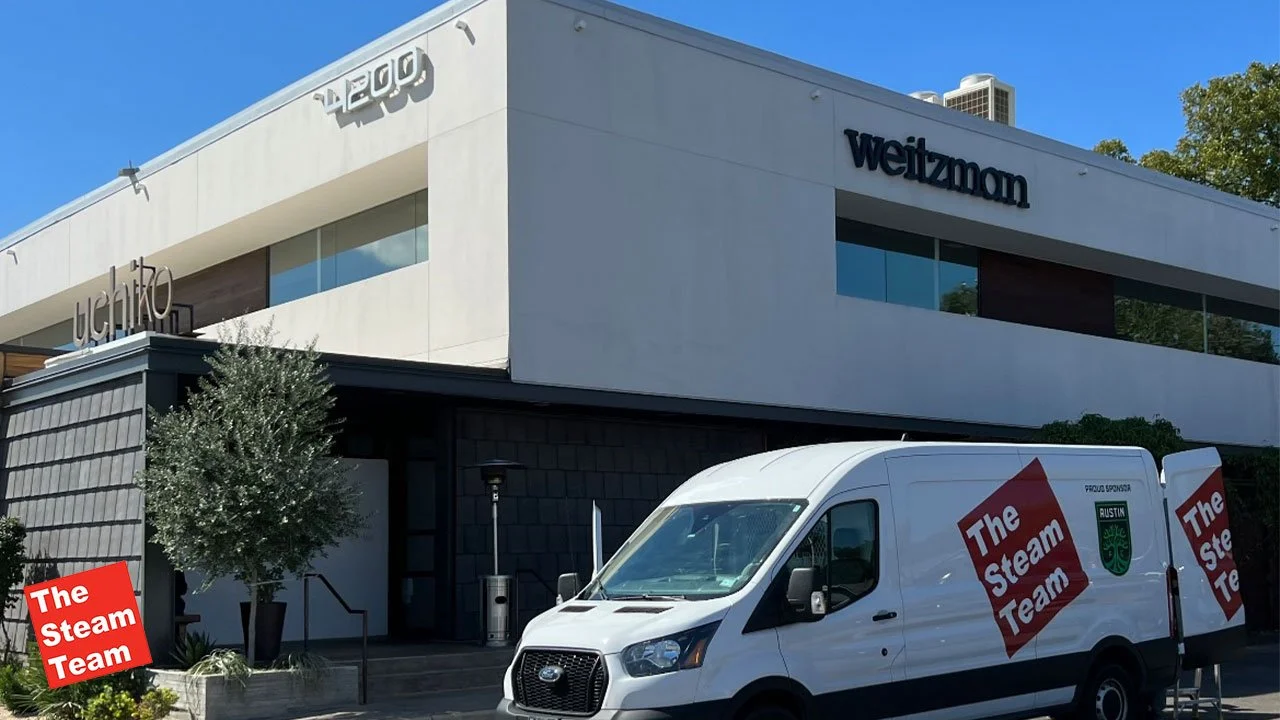
Contact The Steam Team in North Austin
Our restoration crews come to you, day or night, anywhere across Austin and the surrounding communities we serve. Call our North Austin restoration line at any hour to get a crew dispatched to your property. You're also welcome at our 9901 Burnet Rd office to drop off insurance paperwork, meet with our team about your claim, or tour our restoration facility. Spanish-speaking staff is available.
Service areas: Austin, Rollingwood, West Lake Hills, Sunset Valley, Bee Cave, Lakeway, Round Rock, Cedar Park, Pflugerville, Buda, Georgetown, Dripping Springs, Leander, and more.
About Our Warehouse and Industrial Restoration in Austin
In a warehouse or plant, water reaches stock, equipment, and a lot of floor space before anyone can shut it off. Most calls start with one of these:
A burst pipe or fire sprinkler malfunction soaking racks, pallets, and stored inventory
A roof or structural leak dropping water across a large footprint
Flooding at loading docks and open bays after a heavy storm
A machinery or equipment leak under a production line or in an equipment room
A drainage or plumbing failure that leaves standing water across the floor
Warehouse and industrial restoration is the process of stopping the damage in a large commercial or industrial facility, extracting water, drying the building and its contents, sanitizing affected areas, and repairing the structure so operations can resume. It relies on high-capacity extractors, desiccant dehumidifiers, and air movers sized for large open spaces, and it is planned around how the facility runs.
Get your facility back to safe working condition without losing days to coordination. The Steam Team's IICRC-certified technicians take an industrial property through five stages:
Assessment and moisture mapping. A crew inspects the facility with moisture sensors to find where water has traveled across wide areas, including under equipment and into walls.
Water extraction. Industrial pumps and extractors remove thousands of gallons of water quickly, before it spreads into more of the building.
Drying and dehumidification. High-capacity dehumidifiers and air movers dry large open areas, machinery zones, and structural materials to prevent damage and mold.
Cleaning and sanitizing. Affected surfaces are disinfected to remove contaminants and make the workspace safe, with safety standards followed throughout.
Restoration and repair. Walls, flooring, and equipment areas are restored so the facility can return to operation.
What You Get With Every Industrial Restoration Job
24/7 emergency response, with immediate dispatch to limit disruption to operations
High-capacity extractors and desiccant dehumidifiers for large spaces
IICRC Certified Firm (Registration #70666), certified in Water Damage Restoration and Applied Structural Drying
Sanitization and odor control, with OSHA HAZWOPER safety certification
Claim documentation for insurers, including State Farm, Allstate, USAA, Farmers, and Liberty Mutual
Dedicated commercial project managers for clear communication
Locally owned and serving Austin since 1983
Which Facilities Does The Steam Team Restore?
Large facilities have different priorities, so the plan is built around the property and what it holds. The Steam Team restores manufacturing plants, distribution centers, warehouses and storage facilities, office complexes, production lines and equipment rooms, and construction sites and workshops. For offices, retail, and other business properties, see our commercial restoration services page.
What Causes Industrial Water Damage?
The causes our crews respond to most often are burst or leaking industrial pipes, fire sprinkler malfunctions, roof or structural leaks, flooding from storms or heavy rain, equipment or machinery leaks, and drainage and plumbing failures. Acting fast contains the damage, protects inventory, and brings the facility back to safe working condition.
How Quickly Should a Warehouse Respond to Water Damage?
A warehouse should respond immediately. Water spreads across large floor areas and into pallets, packaging, and equipment within hours, and the EPA notes mold can begin growing on damp materials within 24 to 48 hours. Every hour of downtime also delays shipments and production, so calling a 24/7 crew as soon as water is found limits both the damage and the interruption.
Does Insurance Cover Water Damage at a Warehouse or Industrial Facility?
Many commercial property policies cover sudden, accidental water damage such as a burst pipe or a sprinkler malfunction, while gradual leaks and flood damage are often excluded or need separate coverage. Coverage for stored inventory and equipment varies by policy. Your adjuster decides coverage. The Steam Team documents moisture readings, equipment use, and the scope of loss to support your claim with carriers such as State Farm, Allstate, and USAA.
Industrial Water Damage in Austin: What Facility Managers Should Watch For
In large buildings, water can go unnoticed until it reaches stock or machinery. These are the signs and missteps our technicians see most often.
When to Call an Industrial Restoration Professional
Water pooling on a floor that doesn't drain. Our crews extract it with industrial pumps before it spreads across the slab and into walls.
Stained or sagging roof decking or ceiling panels. This usually points to a leak above, which we locate with moisture mapping.
Sprinkler discharge with no fire. We extract the water and dry the area, since a malfunction can soak a large area quickly.
Wet pallets, cartons, or packaging. We document what was affected so your insurer has a clear inventory.
Damp or musty areas near equipment rooms. Our technicians treat this as a sign of hidden moisture and check behind and beneath equipment.
Common Mistakes to Avoid
Relying on fans and open dock doors to dry the building. That moves surface air but can't pull moisture from materials, so we set high-capacity dehumidifiers and air movers sized to the space.
Restarting equipment in a wet area. Electrical and mechanical systems can be damaged or unsafe, so we confirm conditions before anything is powered up.
Discarding inventory without a record. Your insurer will want an itemized account of what was lost, so we document it first.
Resuming operations before moisture readings confirm dryness. Slabs and structural materials can hold moisture after they look dry, so we confirm with meter readings.
What Our Clients Say
“We recently used The Steam Team for water damage restoration in Austin, and I can confidently say they are one of the most professional companies we’ve ever worked with.”
- TEMP-PACK Mobile and Cold Storage
“There truly isn’t another restoration vendor I’ve worked with who is as responsive and dependable. Thank you, Steam Team, for everything you do!”
“Highly recommend them for roofing, water damage restoration, and anything in between!”
Other Services in Austin
Water damage in a large facility usually comes with other problems. Here's how the rest of our restoration services can help.
Commercial Restoration Services
Restore offices, retail centers, schools, and other business properties after water, fire, mold, or storm damage.
Commercial Restoration Services in Austin →
Commercial Water Damage Restoration
Extract water, map hidden moisture, and dry affected areas so your business can reopen without trapped dampness.
Commercial Water Damage Restoration in Austin →
Structural Drying
Dry walls, flooring, and framing thoroughly with commercial-grade dehumidification and airflow systems that reach hidden moisture.
Structural Drying in Austin →
Emergency Response
Get a crew on site any hour to stabilize your facility after a flood, fire, or large loss before damage spreads.
Emergency Response in Austin →
Mold Remediation
Remove mold found in damp insulation, walls, or storage areas with containment, HEPA filtration, and antimicrobial treatment.
Mold Remediation in Austin →
Contents Pack-Out and Storage
Move inventory and equipment out of the affected area with careful inventory, packing, and climate-controlled storage.
Contents Pack-Out and Storage in Austin →
Awards & Certifications
The Steam Team holds the following restoration certifications, licenses, and industry recognition.
Certifications and licenses
IICRC Certified Firm, Registration #70666 — Water Damage Restoration (WRT), Applied Structural Drying (ASD), Fire & Smoke Restoration (FSRT), Applied Microbial Remediation (AMRT), Odor Control (OCT)
Texas Mold Remediation Contractor License (TDLR), #RCO1264
EPA Lead-Safe Certified Firm, License NAT-56770-4
OSHA HAZWOPER Safety Certification
DKI — 10 Year Distinguished Member
Awards
Golden Hammer Award — Water Damage Restoration (2011, 2012, 2020, 2021, 2023, 2024)
Austin American-Statesman "Best of the Best" — Water Damage Restoration Services (2018–2025)
Westlake Business of the Year (2026)
Ratings and memberships
BBB A+ Rating, BBB Accredited Business
Restoration Industry Association (RIA) Member
Building Owners and Managers Association (BOMA) Member
International Facility Management Association (IFMA) Member
What Makes Austin Different for Warehouse and Industrial Restoration
Austin's weather and waterways both put large facilities at risk, and a big footprint means more area to protect.
Long humid summers and sudden storms. Central Texas pairs long, humid summers with sudden, high-intensity rainfall, a pattern climatologists associate with flash-flood risk. A roof leak or a flooded dock can reach a large share of a warehouse floor quickly, and the humidity gives mold an easy start on stock and materials left damp.
Creeks through low-lying areas. Waller Creek, Shoal Creek, and Barton Creek run through parts of Austin with a documented history of flash flooding in low-lying sections. Facilities near these waterways benefit from a 24/7 crew that can begin extraction as soon as water gets inside.
Frequently Asked Questions
How long does it take to dry a warehouse?
Timing depends on how much water got in, the size of the space, and the materials affected. Extraction is done first, then drying continues with moisture readings taken until floors, walls, and structural materials reach normal levels. Your technician explains the expected timeline after the assessment.
Can part of the facility keep operating during restoration?
Sometimes, depending on where the water is and how the building is laid out. Your technician plans the work in sections where possible and explains which areas can stay in use and which need to be closed off for drying or safety.
What happens to my inventory and equipment?
Affected inventory and equipment are documented, and items that must move can be packed out through Contents Pack-Out and Storage and kept in climate-controlled storage. The record supports your insurance claim for anything damaged.
Does sprinkler discharge count as water damage?
Yes. Water from a sprinkler malfunction needs the same extraction, drying, and moisture monitoring as any other water loss, and it can cover a large area quickly. We document the scope to support your claim.
Do you handle repairs after the building is dry?
Yes. The Steam Team restores walls, flooring, and equipment areas once the structure is confirmed dry, so one team holds the records, the scope, and the schedule from the first call through repair.