Protecting Older Austin Homes from Water Damage
/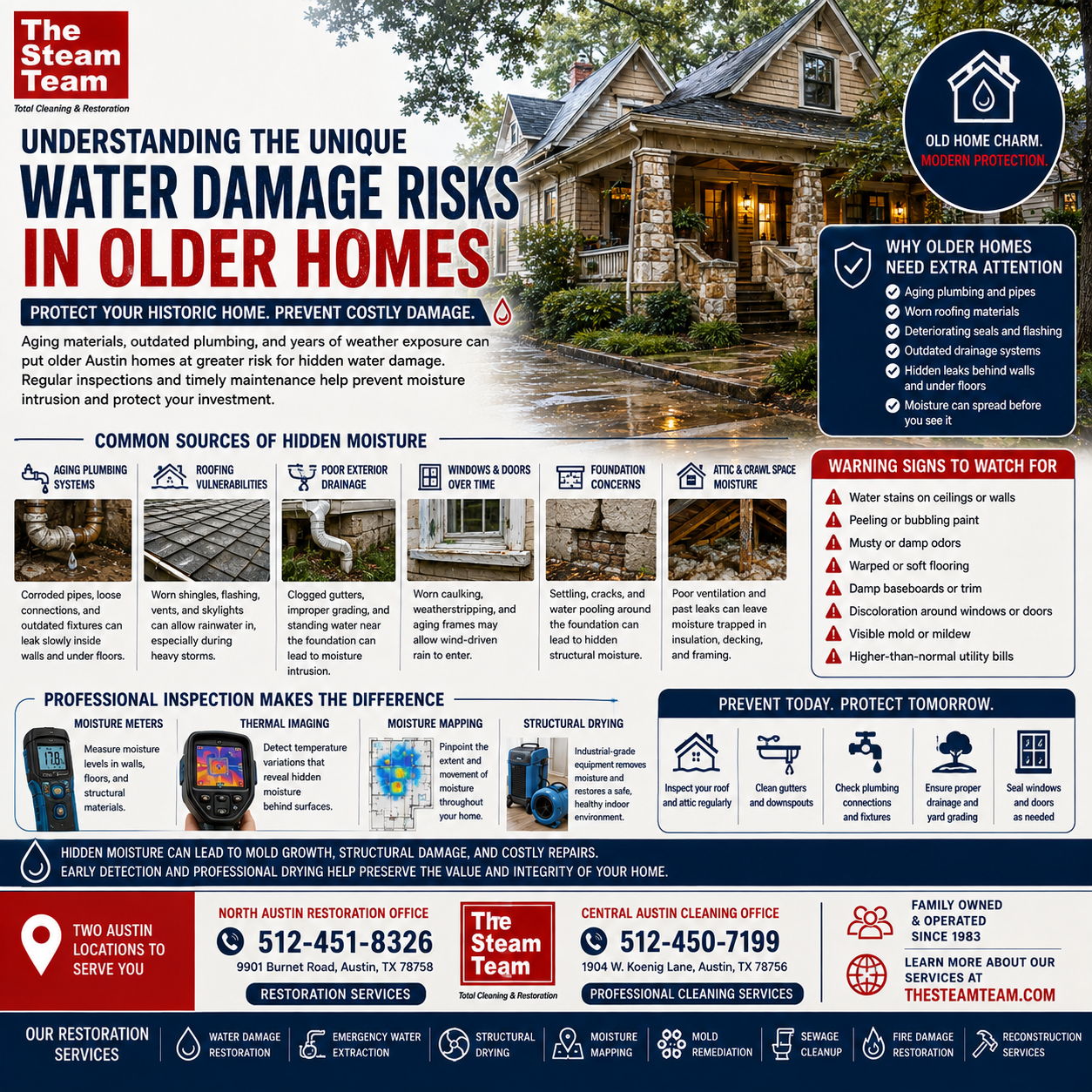
Learn how to protect older Austin homes from water damage, identify common risk areas, recognize hidden moisture, and understand the importance of professional inspections.
Read More
Explore expert tips on water damage restoration, carpet cleaning, rug cleaning, mold remediation, and air duct cleaning in Austin, TX. Trusted local insights from The Steam Team since 1983.
Learn how to protect older Austin homes from water damage, identify common risk areas, recognize hidden moisture, and understand the importance of professional inspections.
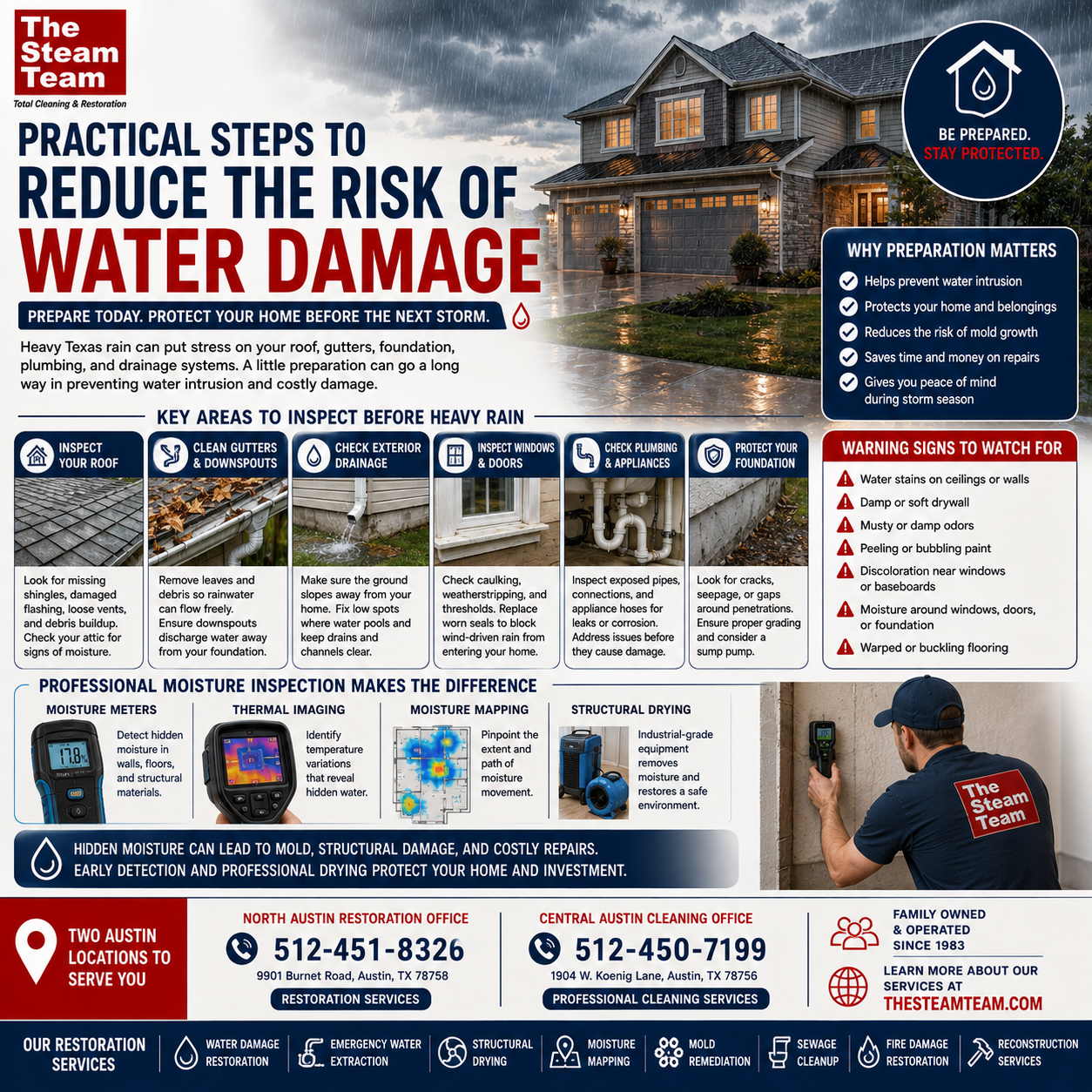
Read MoreLearn how to prepare your Austin home before heavy Texas rain, reduce water intrusion risks, recognize vulnerable areas, and know when to schedule a professional inspection.
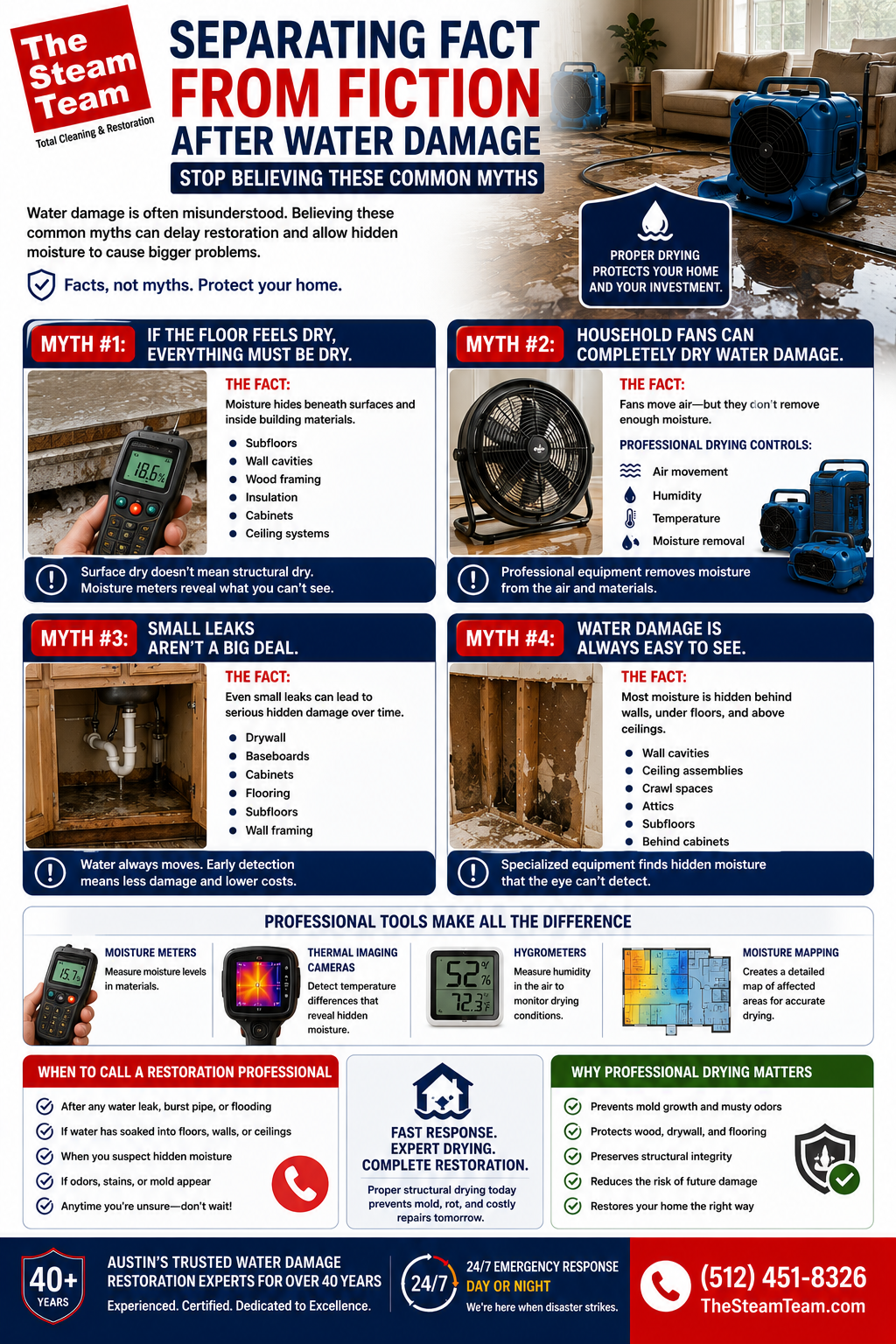
Read MoreDiscover the most common water damage myths homeowners believe and learn the facts about hidden moisture, structural drying, restoration, and professional water damage cleanup.
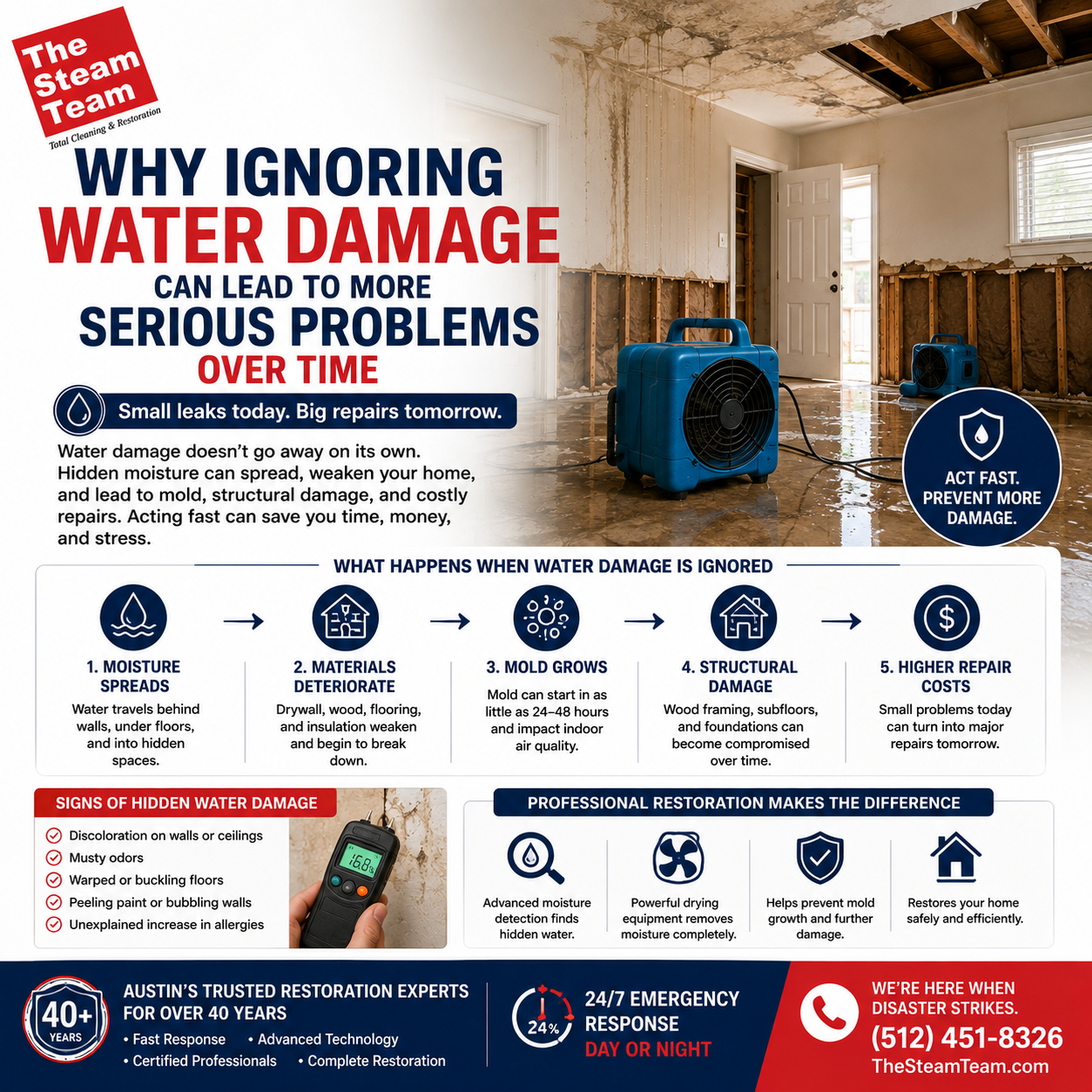
Read MoreDiscover what happens when water damage is left untreated. Learn how hidden moisture can affect your home's structure, flooring, walls, and indoor environment, and why acting quickly matters.
Read MoreWater damage occurs the moment water intrudes into building materials, and when left unaddressed, it rapidly degrades structure, drives mold growth, and raises health and financial risks. This article explains why acting quickly after a flood, burst pipe, or storm-related intrusion matters, outlining immediate hazards, health consequences, cost escalation, the professional restoration workflow, and prevention steps tailored to Austin and Central Texas conditions. Readers will learn how moisture attacks wood, drywall, insulation, and foundations; how mold and bacterial contaminants develop; and which mitigation steps reduce exposure and restore habitability. The guide maps the restoration process step-by-step, extraction, drying, remediation, contents care, and reconstruction, and shows how response time changes outcomes. Practical checklists, comparative EAV tables, and clear lists help homeowners and property managers prioritize actions and document damage for insurance. Practical, local considerations and certified-expert options are included to help you decide when to call professionals and what to expect from emergency water damage restoration.
Immediate risks begin as soon as water contacts building materials and escalate with time; the three primary early threats are structural weakening, biological growth, and electrical or safety hazards. Water saturates porous materials, reducing tensile strength in wood and drywall, and can compromise fasteners and adhesives within hours to days, which increases collapse risk in affected areas. Simultaneously, wet surfaces create ideal conditions for mold and bacterial colonization that can begin within 24–48 hours, increasing contamination and complicating cleanup. Finally, standing water and moisture accelerate corrosion of electrical systems and create slip, trip, and contamination hazards that make occupied spaces unsafe. The next subsections examine how different materials fail and how quickly mold takes hold, offering specific mitigation actions to halt progressive deterioration.
Water undermines structural elements by penetrating and saturating materials, which reduces load-bearing capacity and accelerates decay in wood, gypsum, and insulation. Wood framing and joists absorb moisture, which causes swelling, warping, and eventual rot if not dried; fasteners corrode, and connections weaken, creating hidden failures that become apparent later during reconstruction. Drywall and insulation quickly lose stiffness and thermal performance, often requiring removal once saturation and contamination exceed safe-drying thresholds, which increases project scope. Foundations and slabs can experience hydrostatic pressure and soil movement after prolonged exposure, potentially leading to cracks and settlement; early mitigation focuses on removing water and lowering moisture content to prevent long-term shifts. Understanding these material-specific failure modes guides targeted mitigation tactics such as temporary shoring, controlled drying, and selective demolition to preserve as much of the original structure as possible.
Mold growth typically begins within 24–48 hours on damp, nutrient-rich surfaces when temperature and humidity are favorable, and spores find organic material to colonize. Warm, dark environments and porous substrates like wood, paper-faced drywall, and insulation accelerate colonization and biofilm formation, turning localized moisture into broader contamination if left untreated. Early drying, HVAC isolation, and containment can arrest spore germination and limit spread; once visible growth appears, remediation requires removal or specialized cleaning depending on material and contamination class. Prompt actions such as extracting standing water and deploying air movers and dehumidifiers reduce the window for mold establishment and cut the eventual complexity and cost of remediation. The next section examines how timely restoration reduces health hazards associated with mold and bacteria in the home.
The Institute of Inspection, Cleaning and Restoration Certification (IICRC) provides essential frameworks for understanding and managing water damage, including how to classify water intrusion and establish drying goals.
IICRC Water Damage Classification for Structural Drying
The Institute of Inspection, Cleaning and Restoration Certification (IICRC) categorizes free water into three classes based on the estimated evaporation rate and the percentage of the structure's surface area that is affected. Understanding these categories is crucial for establishing appropriate in-place structural drying goals.
Establishing In-Place Structural Drying Goals: A Scientific Approach, 2015
Timely restoration reduces exposure to biological contaminants by removing moisture and contaminated materials before spores and pathogens amplify to hazardous levels. Drying and remediation interrupt the chain of events that leads from humidity to mold proliferation and bacterial growth, lowering airborne spore counts and limiting reservoirs of contamination in HVAC systems, carpets, and contents. Professional containment strategies and HEPA-grade filtration capture airborne particulates during cleanup, reducing respiratory exposures for occupants and workers alike and protecting vulnerable populations such as children, the elderly, and immunocompromised individuals. Table-based mapping of common contaminants to health impacts clarifies what to prioritize during mitigation and when to pursue specialized remediation or medical consultation. The following subsection lists common health issues tied to mold and bacteria and then explains how professional remediation reduces those risks.
Exposure to mold and waterborne bacteria commonly causes respiratory irritation, allergic responses, and exacerbation of asthma or chronic lung conditions in sensitive individuals. Symptoms can include coughing, nasal congestion, wheezing, eye irritation, and chronic sinus issues; those with compromised immune systems are at higher risk of opportunistic infections from certain pathogens present in contaminated water. Prolonged exposure to high indoor mold concentrations has been associated with persistent respiratory problems and reduced indoor air quality, which can impair daily functioning and increase healthcare interactions. Early mitigation lowers airborne and surface contamination, which in turn reduces symptom persistence and the chance of chronic issues developing in at-risk occupants. The next subsection explains specific professional remediation steps that protect occupants and limit re-exposure.
Research into indoor fungi and water damage highlights the critical need for adherence to established guidelines to protect occupants from adverse health effects.
Health Effects and Guidelines for Indoor Mold and Water Damage
Cedric holds a current IICRC certification for water damage restoration and applied microbial remediation and has also been involved in research on indoor fungi, mould remediation, cleaning, and indoor air. This paper reviews current research on health effects and accepted guidelines for the management of indoor mould and water damage in the built environment.
Literature review of current research on health effects and accepted guidelines for the management of indoor mould and water damage in the built environment, CD Cheong, 2013
Professional mold remediation protects occupants by combining containment, negative-pressure airflow, HEPA filtration, and methodical removal of contaminated materials to prevent cross-contamination. Remediation teams assess contamination levels, seal affected zones, and use negative air machines with HEPA filtration to keep spores from migrating to clean areas while technicians remove or clean affected components per industry standards. Specialized cleaning agents and antimicrobial treatments reduce surface-bound organisms, and post-remediation verification, including visual inspection and moisture readings, confirms that conditions are safe for reoccupation. When remediation follows rapid extraction and drying, the combined approach minimizes long-term occupant exposure and preserves as much of the home’s value and finishes as possible while preparing the property for reconstruction. The next section outlines how delaying these steps increases overall restoration costs.
Adhering to professional standards is paramount for ensuring that mold remediation is conducted safely and effectively, minimizing risks to both property and occupants.
IICRC Professional Mold Remediation Standards
The Institute of Inspection, Cleaning and Restoration Certification (IICRC) administers the process and establishes policies, procedures, and guidelines to ensure that mold remediation is performed safely and effectively. This guide provides a comprehensive overview of mold remediation issues.
Reference Guide for Professional Mold Remediation, 2003
Delaying repair multiplies costs by expanding the damage footprint, increasing demolition needs, and adding mold remediation and contents replacement to the bill. Immediate mitigation limits expenses to extraction and drying, while waiting 48 hours or more often requires removal of finishes, replacement of building materials, and more extensive labor hours. Insurers may categorize damage differently based on contamination class and mitigation timeliness, which affects coverage decisions and out-of-pocket expenses for homeowners; well-documented, prompt mitigation helps align expectations during the claims process.
Early mitigation narrows the scope of reconstruction and preserves finishes, lowering both direct repair costs and indirect costs such as temporary relocation or business interruption. Quick action preserves contents through proper pack-out and cleaning, which reduces replacement expenses and shortens downtime for occupants and businesses. The final subsection offers a stepwise approach to how delays amplify costs and what homeowners should document when filing claims in Austin.
Response Time
Impact Area
Typical Outcome
Immediate (0–24 hours)
Structural materials & contents
Mostly salvageable finishes; focused extraction and drying; limited demolition
Short delay (24–72 hours)
Mold & microbial growth
Increased likelihood of mold remediation, partial demolition, and higher labor hours
Extended delay (1 week+)
Structural integrity & reconstruction
Widespread demolition, structural repairs, and contents replacement, the highest cost and downtime
This table shows how faster responses preserve materials and reduce downstream reconstruction. Prioritizing immediate mitigation constrains project scope, while extended delays compound labor and replacement costs, underscoring the financial importance of rapid action.
Waiting increases restoration costs primarily by converting repairable items into replaceable ones and enlarging the zone of required remediation or demolition. Small, localized water incidents may be addressed with extraction and drying, but as moisture migrates into cavities and assemblies, remediation expands to include insulation, drywall, subflooring, and even structural members. Secondary damages such as mold colonization or corrosion require specialized remediation and longer project timelines, raising labor and project management costs and often necessitating contents replacement or advanced reconstruction. Quick mitigation limits these multipliers, preserving finishes and reducing the scope of reconstruction, which in turn shortens overall project duration and total expense.
Filing an insurance claim promptly requires organized documentation, immediate mitigation steps, and clear communication with adjusters to expedite coverage decisions and reduce disputes. Homeowners should photograph damage with timestamps, retain receipts for emergency mitigation work, and request written estimates from qualified restoration professionals to support claims.
Restoration companies frequently assist by providing detailed scope-of-loss reports, moisture mapping, and coordinated communication with insurance adjusters to streamline claim handling and avoid coverage delays. Maintaining these records and initiating mitigation quickly increases the probability that insurers will view the loss as properly managed, which can reduce contention and speed settlement; the next section maps the restoration workflow where rapid professional involvement matters most.
The professional restoration process unfolds in defined phases: emergency mitigation, structural drying, remediation/contents restoration, and reconstruction, and each phase relies on prompt initiation to prevent secondary damage. Emergency mitigation focuses on removing standing water and stabilizing the property to stop ongoing damage, followed immediately by controlled drying and dehumidification using industry-grade equipment and moisture monitoring. Remediation addresses contamination and mold via containment and specialized cleaning, while contents restoration and reconstruction return the property to pre-loss condition with coordinated scheduling to minimize downtime.
Prompt emergency response is especially critical because early extraction and drying reduce the time during which biological growth and material degradation occur; this trims remediation needs and limits reconstruction scope. The following subsection explains extraction and drying tools and monitoring protocols, while the subsequent subsection covers reconstruction’s role in full recovery and continuity benefits.
Phase
Typical Timeframe
Primary Goal
Extraction & Mitigation
Hours to 1 day
Remove standing water, secure utilities, protect contents
Drying & Monitoring
2–7 days (variable)
Reduce material moisture to acceptable levels; prevent mold
Remediation & Contents Care
1–10 days
Remove contaminated materials; clean and restore personal property
Reconstruction & Repair
Days to months
Rebuild affected areas to pre-loss condition; ensure code compliance
This process table demonstrates how each phase has time-sensitive objectives: delays in early phases amplify the workload and cost in later phases, which is why rapid, coordinated action is essential for effective restoration.
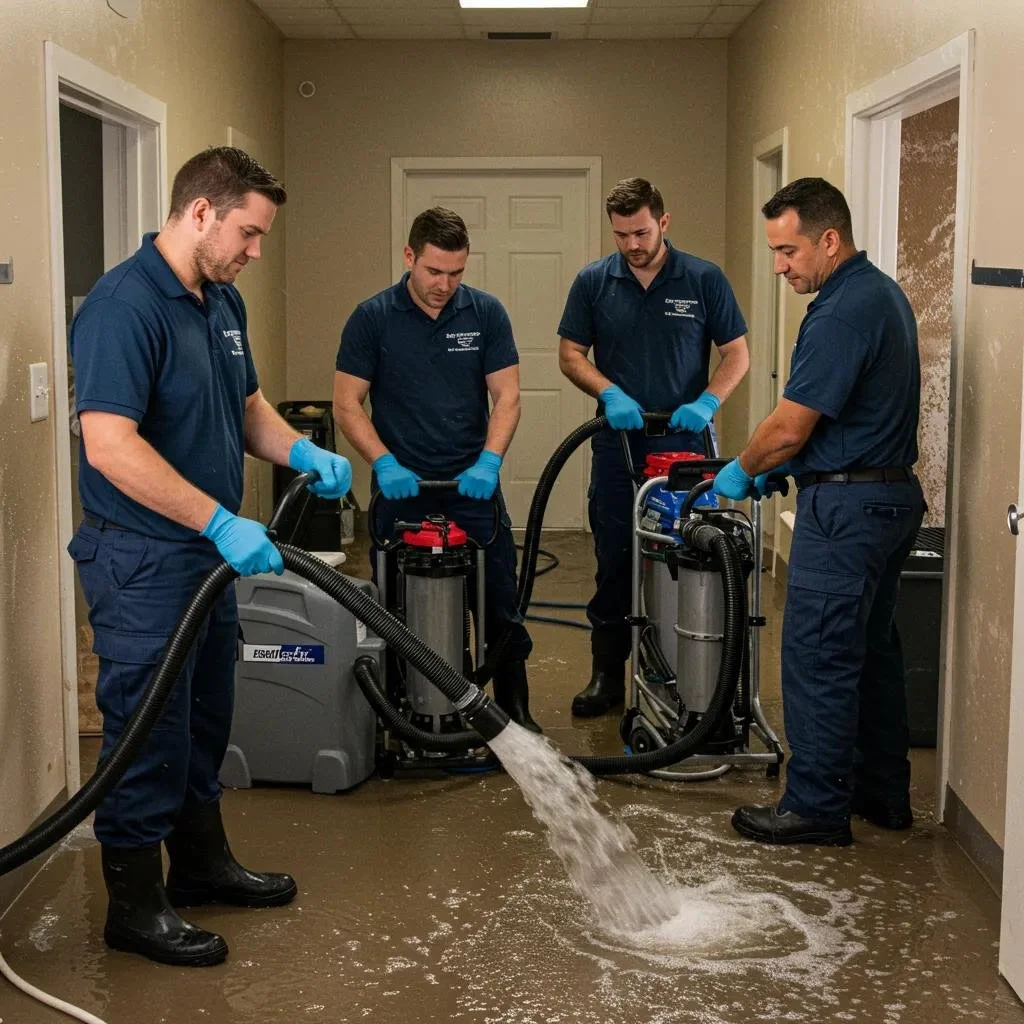
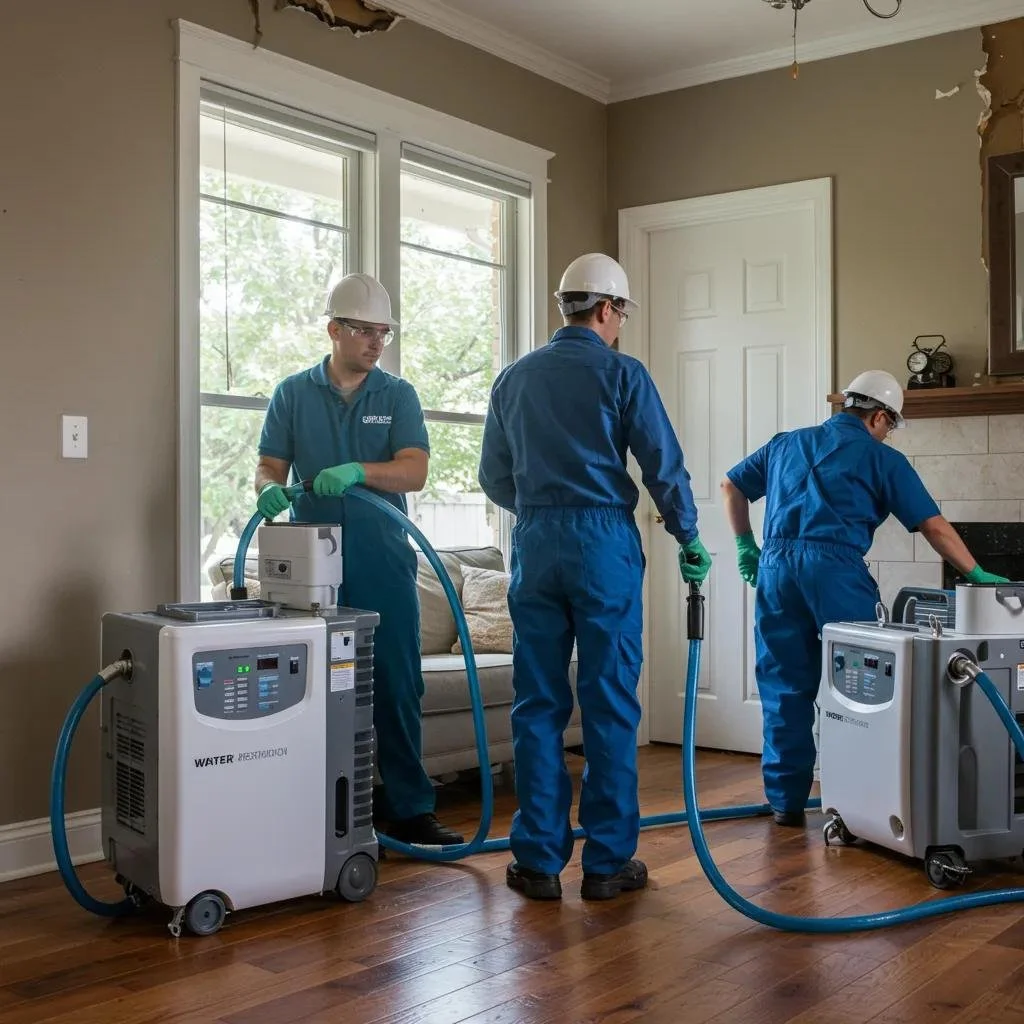
Emergency extraction and structural drying use high-capacity pumps, portable extractors, air movers, and commercial dehumidifiers to remove standing water and evaporate bound moisture from materials. Extraction equipment eliminates bulk water rapidly, while air movers increase evaporation rates and dehumidifiers remove moisture from the air to prevent re-saturation; technicians use moisture meters and thermal imaging to map wet zones and guide drying strategies. Continuous monitoring documents progress and ensures that moisture levels return to safe baselines before reconstruction begins, preventing concealed wet pockets that later drive mold or structural problems. Proper sequencing, extraction, containment, targeted drying, and documented verification are what reduce rework and preserve materials for restoration rather than replacement.
Full-service reconstruction completes recovery by repairing structural components, replacing finishes, and restoring systems to meet building standards and occupant needs, often coordinating with mitigation teams to streamline schedules. A single provider that manages mitigation through reconstruction can preserve institutional knowledge about the loss, expedite material procurement, and maintain quality control across trades to reduce coordination gaps. Reconstruction also addresses concealed damage uncovered during mitigation, integrates code-required repairs, and documents work for insurance reconciliation, which helps close claims efficiently. Choosing a provider that offers seamless continuity from extraction through rebuild shortens project timelines and reduces the administrative burden on homeowners and property managers.
After describing the restoration workflow and timelines, it is helpful to note how rapid professional deployment maps to these phases in practice.
Choosing a certified local expert matters because technicians familiar with Austin’s building stock, climate-driven risks, and common roofing and drainage patterns can act faster and make remediation choices that suit regional conditions. Certifications indicate adherence to industry methods and training: IICRC-aligned practices guide proper mitigation and drying protocols that reduce rework and encourage reliable outcomes. Local credentials, award recognition, and a strong business rating offer third-party signals that help homeowners evaluate providers; these credibility markers, combined with 24/7 availability, reduce decision friction during an emergency. The next subsections describe how rapid local response minimizes loss and which certifications and ratings are relevant when comparing providers.
Rapid dispatch shortens exposure time and prevents moisture from migrating into concealed assemblies, which reduces the need for demolition and speeds recovery to pre-loss condition. The Steam Team’s 24/7 emergency water damage restoration capability enables early extraction, targeted drying, and immediate containment steps that constrain mold growth and preserve finishes and contents. Prompt documentation and coordination with homeowners and insurers also accelerate claims processing, while local familiarity with Austin construction types informs targeted mitigation that prevents common regional failure modes. Early intervention by a responsive team, therefore, converts a potentially large reconstruction project into a more manageable restoration scope.
Industry certifications and independent ratings serve as objective trust signals that a provider follows accepted practices and maintains quality systems. IICRC certification demonstrates technician training in restoration standards and protocols, which improves the likelihood that drying, remediation, and contents restoration are performed according to recognized methods. Independent business ratings and local award acknowledgments provide additional evidence of reliable service and customer satisfaction in the community, which helps homeowners choose a partner for time-sensitive restoration work. When evaluating providers, ask about certifications, verification of procedures, and references to ensure that the team you select applies current standards and proven methodologies.
Preventing water damage combines seasonal maintenance, infrastructure checks, and readiness measures that reduce the probability and impact of water intrusion events. Regular inspections of gutters, roof penetrations, HVAC condensate lines, and plumbing fixtures catch small failures before they escalate into significant leaks. Installing or monitoring drainage improvements around foundations and using smart sensors for early leak detection can alert homeowners to problems while they are still manageable. The following subsections list common local causes of damage and provide a maintenance schedule to lower future risk and limit restoration needs.
In Austin, common causes of water damage include severe storms and flash flooding, burst or leaking pipes, clogged gutters and downspouts, and HVAC condensation failures. Stormwater infiltration can overwhelm grading and drainage systems, entering basements, crawlspaces, and low-lying rooms; plumbing failures range from pinhole leaks that silently soak assemblies to sudden pipe bursts that cause immediate standing water. Clogged gutters allow roof runoff to back up under shingles and into soffits, while neglected HVAC coils and drain lines create slow leaks that undermine ceilings and insulation over time. Addressing these failure modes through routine inspection and timely repair reduces the chance of emergency restoration.
A consistent inspection schedule and preventive maintenance program catch deterioration early and reduce both frequency and severity of water events, preserving property value and lowering insurance exposure. Quarterly checks of gutter systems, seasonal roof inspections before rainy periods, annual plumbing system reviews, and routine HVAC service prevent common failure points and allow homeowners to replace worn components proactively. Simple homeowner actions clearing gutters, monitoring crawlspace moisture, and watching for unexplained increases in water bills, provide early warning signs that prompt professional evaluation. Implementing these measures creates a pattern of care that limits the need for emergency restoration and keeps downtime and repair costs to a minimum.
Regular maintenance reduces the incidence and severity of water events by detecting issues early.
Seasonal inspections align resources with Austin’s weather patterns and protect vulnerable building elements.
Proactive repairs and monitoring preserve finishes and mitigate potential mold and structural damage.
Inspection Area
Recommended Frequency
Preventive Action
Gutters & Downspouts
Before the rainy season/quarterly
Clean debris; verify proper drainage away from the foundation
Roof & Flashings
Annually and after storms
Inspect for damaged shingles or penetrations; seal as needed
Plumbing & Valves
Annually
Check for leaks, corrosion, and pressure issues; service or replace aging components
Inspect gutters and downspouts at least twice a year to prevent overflow and foundation seepage.
Schedule seasonal HVAC maintenance to prevent condensate leaks and maintain proper airflow.
Monitor crawlspaces and basements with periodic visual checks and moisture meters if possible.
These checklist items help homeowners create a practical, repeatable prevention plan that reduces the likelihood and impact of water intrusion events and supports faster recovery when incidents occur.
Upon discovering water damage, the first step is to ensure safety by turning off electricity in affected areas and avoiding contact with standing water. Next, document the damage with photos for insurance purposes. If possible, remove any valuable items from the area to prevent further loss. Begin the drying process by using fans and dehumidifiers, and if the damage is extensive, contact a professional restoration service immediately to mitigate further risks and initiate the restoration process.
Hidden water damage can often be detected through signs such as water stains on walls or ceilings, a musty odor, or visible mold growth. Additionally, check for warped or buckled flooring and soft spots in walls or ceilings. Using moisture meters can help identify damp areas behind walls or under floors. Regular inspections of plumbing fixtures and appliances can also help catch leaks before they cause significant damage.
If your insurance claim for water damage is denied, first review the denial letter to understand the reasons. Common issues include a lack of documentation or failure to meet policy requirements. Gather all relevant evidence, including photos, repair estimates, and any communication with your insurer. You can appeal the decision by providing additional information or seeking assistance from a public adjuster who can advocate on your behalf to negotiate with the insurance company.
To prevent mold growth after water damage, it is crucial to dry the affected area within 24-48 hours. Use dehumidifiers and fans to reduce moisture levels and ensure proper ventilation. Remove any wet materials that cannot be dried, such as carpets or insulation. Regularly inspect areas prone to moisture, such as bathrooms and basements, and consider using mold-resistant products during repairs. If mold is already present, professional remediation may be necessary to ensure complete removal.
Long-term effects of water damage on property value can be significant. Properties with a history of water damage may face decreased marketability and lower appraisals. Structural issues, mold growth, and health concerns can deter potential buyers, leading to prolonged vacancies or reduced sale prices. Additionally, if repairs are not properly documented, it may complicate future transactions. Regular maintenance and prompt repairs can help mitigate these risks and preserve property value over time.
Yes, Austin has specific regulations and guidelines for water damage restoration that align with state and federal standards. Restoration companies must adhere to the Texas Department of Insurance regulations and follow IICRC standards for water damage restoration. Additionally, local building codes may dictate specific requirements for repairs and renovations following water damage. Homeowners should ensure that any restoration work is performed by licensed professionals familiar with these regulations to avoid potential legal issues.
Timely water damage repair is essential for preserving structural integrity, preventing mold growth, and minimizing health risks. By understanding the immediate dangers and the restoration process, homeowners can make informed decisions that protect their property and well-being. Don't wait for damage to escalate; take proactive steps to mitigate risks and ensure a safe living environment. Contact a certified local expert today to explore your options for effective water damage restoration.
Water removal and restoration is the professional process of removing standing water, drying affected materials, and restoring a property to safe, usable condition; acting quickly preserves structure, limits mold growth, and reduces long-term repair costs. This guide explains what homeowners and businesses in Austin and Central Texas should expect from emergency water extraction through final reconstruction, with practical timelines and actionable steps you can use immediately. You will learn how emergency dispatch and intake work, how technicians assess and document damage, the drying and monitoring methods used to prevent mold, and how repairs and insurance coordination proceed. The Steam Team’s local response capabilities—IICRC-certified technicians, 24/7 emergency dispatch, preferred-vendor relationships with insurers, and service across Austin and Central Texas—help streamline the process when professional help is needed. After outlining each phase we provide clear checklists, equipment comparisons, and cost drivers so you can make informed decisions and reduce surprises during restoration. Read on for step-by-step expectations, what to do first, and how to work with restoration professionals and your insurer to recover efficiently.
Emergency water extraction is the rapid-response sequence of call intake, onsite safety triage, bulk water removal, and immediate mitigation to stabilize a property and prevent further damage. Technicians focus first on occupant safety and hazard control, then remove standing water with high-capacity pumps and vacuums, and finally set containment and drying equipment to limit moisture migration. Rapid extraction reduces saturation of porous materials and shortens drying time, which in turn lowers mold risk and reconstruction scope. Understanding the typical steps helps homeowners act appropriately during the first hours after a leak or flood and prepares them for what crews will do when they arrive.
When you call for emergency water removal, the intake agent collects core facts: location, type of water intrusion, visible damage, and safety concerns; this information prioritizes dispatch and equipment selection. While waiting for crews, homeowners should turn off electricity if safe, move valuables to higher ground, and avoid contact with contaminated water to reduce health risks. Expect the dispatch process to include estimated arrival time, instructions for safety, and confirmation of access points, and crews typically arrive prepared to secure utilities and begin assessment. These initial actions both protect occupants and shorten the overall restoration timeline by enabling crews to start mitigation immediately.
Typical intake questions focus on location, water source, and hazards.
Immediate homeowner actions include shutting off electricity, moving possessions, and keeping pets away.
Dispatch uses the intake to decide pump types and crew size.
This quick preparation improves crew efficiency and leads directly into the initial assessment and extraction steps that follow on arrival.
Effective extraction relies on the right pump and vacuum tools for the situation: submersible pumps handle deep standing water, truck-mounted pumps are used for high-volume floodwater, and portable wet/dry vacuums remove residual water in interior spaces. Each tool is chosen for depth, access, and contamination level; for example, submersibles excel in basements while portable vacuums allow technicians to reach corners and under cabinets. Crews also use containment barriers and sanitary measures to separate clean areas from contaminated zones, which reduces cross-contamination and speeds safe cleanup. Understanding equipment selection clarifies why some jobs require more time or heavier machinery and sets realistic expectations for homeowners.
Submersible pumps remove deep water from basements and excavations.
Truck-mounted pumps move high volumes quickly during major floods.
Portable wet/dry vacuums and extractors handle interior and finish-level removal.
These choices lead into timing expectations because the selected equipment directly affects how long extraction takes.
Extraction time varies with severity: a small pipe leak may require a few hours, a localized flooded room typically takes several hours to a day, and a basement or storm flood can take a full day or longer depending on access and volume. Variables that extend extraction time include water category (contaminated water requires careful removal), structural complexity, and safety hazards that slow entry or require remediation before water removal. Extraction is the first and often fastest visible phase, but hidden moisture and drying protocols continue after pumps are removed, so plan for multi-day monitoring and equipment presence. Recognizing these phases helps homeowners schedule insurance adjuster visits and anticipate when reconstruction planning can begin.
A thorough water damage assessment identifies the source, classifies the water, maps moisture intrusion, and defines the scope of mitigation and repairs using diagnostic tools and documentation. Technicians trace leaks, inspect structural assemblies, and classify affected materials so the drying and repair plan addresses both visible and hidden damage. Accurate assessment minimizes surprises during restoration and creates a clear scope for insurance and repair budgeting. The next subsection explains how sources and contamination levels are identified and why that classification matters for safety and remediation.
Technicians locate sources by tracing visible wet paths, checking plumbing fixtures, and inspecting roof and foundation penetrations; they also consider recent weather and drainage issues when tracing storm-related damage. Water is categorized by contamination level—clean, gray, or black—which determines protective measures and disposal methods, and this classification also affects insurance coverage and repair protocols. Safety measures differ by category: contaminated water may require full PPE, containment, and specialized disposal, while clean water focuses on structural drying. Knowing the source and category guides both immediate mitigation and the longer-term restoration decisions homeowners will face.
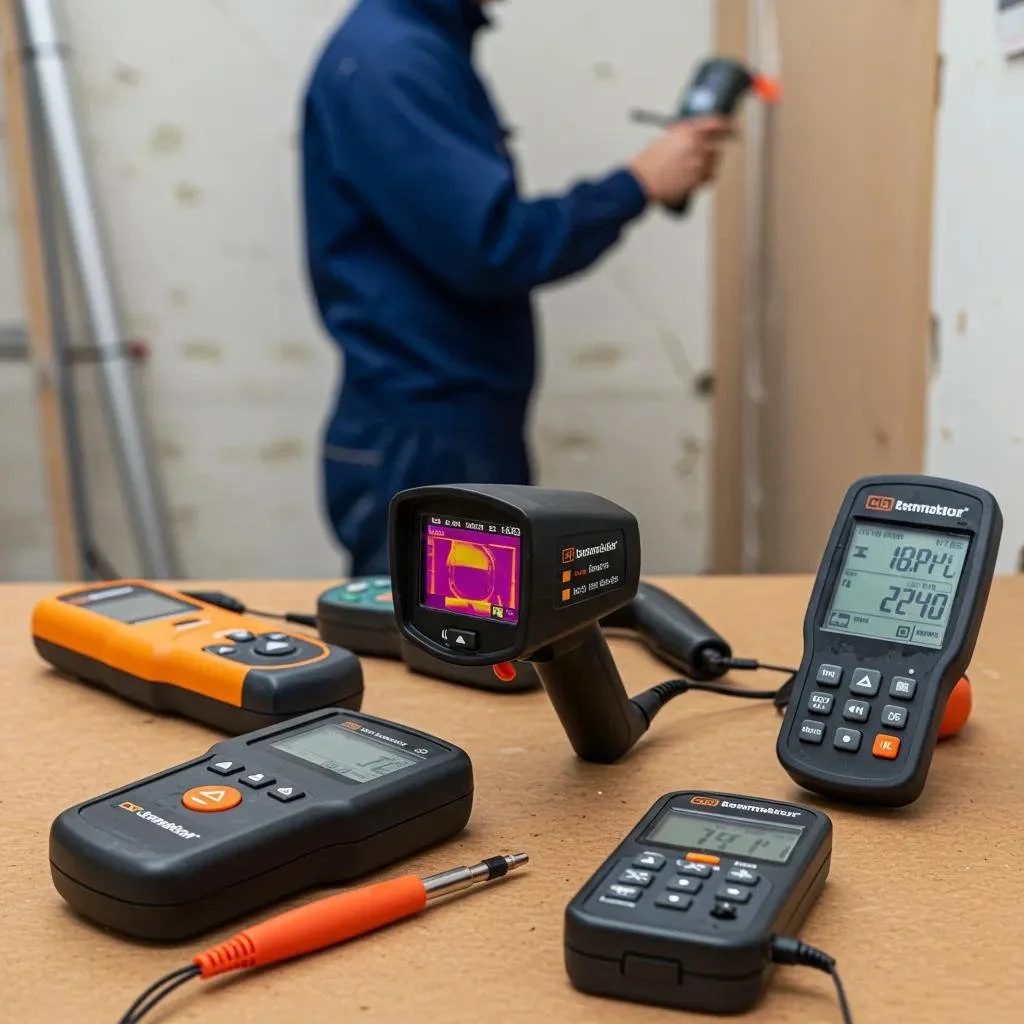
Technicians use a combination of non-invasive and invasive tools—thermal imaging cameras to reveal cold/wet zones, moisture meters for percentage readings in materials, and hygrometers to measure ambient humidity—so they can map moisture and target drying effectively. These tools produce a moisture map that informs equipment placement and drying targets, and repeated measurements document progress for homeowners and insurers. The table below compares common diagnostic tools, their measurement attribute, and typical use cases to clarify why multiple methods are often used together.
Introductory note: The table below helps homeowners understand the main inspection tools and why technicians use them in combination.
| Tool | Measurement | Typical Use |
|---|---|---|
| Thermal imaging camera | Surface temperature differences (visual heat map) | Locate hidden moisture in walls and ceilings non-invasively |
| Pin-type moisture meter | Percent moisture in wood and drywall cores | Verify material saturation and confirm drying targets |
| Hygrometer | Relative humidity and temperature | Track ambient drying conditions and dew point |
| Borescope | Visual inspection inside cavities | Inspect wall cavities without full demolition |
This comparison shows how each tool contributes unique data to create a complete moisture map that drives the drying plan and documentation for claims.
A customized plan combines inspection data, building materials, occupancy needs, and safety considerations into a prioritized mitigation and drying strategy with clear milestones. Technicians set drying goals (target moisture levels), select equipment and containment methods, and estimate timelines while documenting the scope with photos and moisture logs for homeowners and insurers. The plan is flexible: crews update equipment placement and run times based on monitoring results until drying goals are met. Clear documentation and homeowner communication during this phase reduce surprises and prepare the project for reconstruction planning once moisture targets are achieved.
Drying and dehumidification are the controlled removal of moisture from air and materials using air movers, dehumidifiers, and containment to halt deterioration and stop mold growth; the process is monitored until materials meet target dryness levels. Proper equipment balance—sufficient airflow plus appropriate moisture-extraction capacity—drives efficient drying and prevents secondary damage. Monitoring protocols establish baseline readings and frequent checks to adjust equipment and document progress. The following subsections detail equipment types, monitoring methods, and why timeliness is critical to prevent mold.
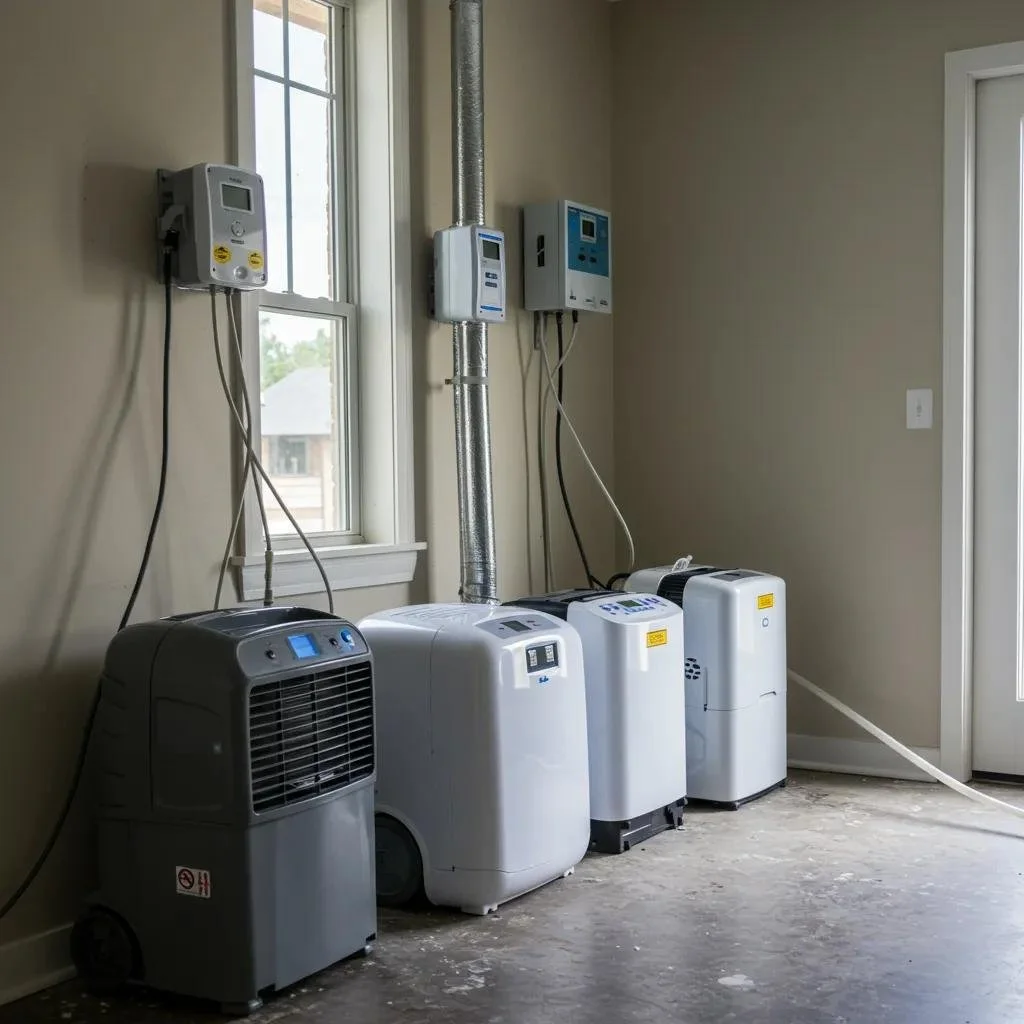
Common industrial equipment includes high-velocity air movers that increase evaporation, low-grain refrigerant (LGR) dehumidifiers that remove moisture from air efficiently in typical interiors, and desiccant dehumidifiers for low-temperature or high-moisture environments like attics or crawlspaces. Each machine has performance metrics—air movers measured in CFM, dehumidifiers in pints/day—that determine how many units a job needs for target drying. Technicians select equipment based on the moisture load, ambient conditions, and the materials affected to avoid over- or under-drying. The EAV table below summarizes typical performance ranges and applications to clarify why multiple machine types are used together.
Introductory note: This table compares common drying equipment by airflow, moisture removal rate, and optimal applications to show practical selection criteria.
| Equipment | Airflow / Capacity | Typical Application |
|---|---|---|
| Air mover | 1,200–2,800 CFM (each) | Increase evaporation across floors and walls |
| LGR dehumidifier | 50–130 pints/day | Interior spaces, basements, when temps are moderate |
| Desiccant dehumidifier | 20–200+ pints/day (effective at low temps) | Crawlspaces, attics, cold environments |
The comparison illustrates why technicians pair air movers with dehumidifiers and choose desiccants where refrigerant units are less effective.
Hidden moisture is monitored through scheduled readings using surface meters, pin meters for invasive checks, and thermal scans to validate drying progress and detect rebound pockets; technicians log values to demonstrate trend improvements. Monitoring frequency typically begins daily and then reduces as readings approach target moisture levels, with a documented acceptance threshold defined in the drying plan. This documentation assures homeowners and insurers that drying met industry standards before repair work begins, and it informs any adjustments needed to equipment or containment. Regular logs also prevent premature removal of equipment, which could allow moisture to re-equilibrate and restart deterioration.
Timely drying stops the biological process that allows mold to colonize porous materials: mold spores can begin growing within 24–48 hours on moist substrates, and prolonged high humidity accelerates spread and increases remediation complexity. Rapid evaporation and dehumidification reduce the window for mold establishment, lower health risks, and limit salvageable materials, which reduces reconstruction scope. Delayed drying typically requires mold remediation steps that increase cost and project duration, so immediate mitigation after extraction is essential. Understanding this timeline helps homeowners prioritize fast response and continuous monitoring until materials reach safe moisture levels.
Mold prevention and remediation combine accurate identification, safe containment and removal protocols, and follow-up clearance testing to restore a healthy indoor environment after water incidents. Proper remediation follows assessment results and may include targeted removal of affected materials, HEPA filtration, and containment to protect unaffected areas while preventing spore spread. Homeowners should expect clear documentation of actions and recommendations for preventing recurrence. The subsections below address detection, health considerations, and prioritized prevention measures to avoid future problems.
Mold is identified through visual inspection, moisture mapping, and targeted sampling when needed to guide remediation strategy; visual cues, musty odors, and persistent moisture readings often justify removal without sampling. Safe removal uses containment, negative air pressure with HEPA filtration, and removal or cleaning of impacted materials according to contamination level and material salvageability. Clearance testing or post-remediation verification may be performed to confirm that remediation achieved acceptable levels and moisture targets are stable. This structured approach minimizes exposure risks during removal and supports insurance documentation for both mitigation and remediation phases.
Inspection methods include visual, moisture mapping, and selective sampling when results will change the remediation scope.
Containment and HEPA filtration prevent cross-contamination during active remediation.
Clearance testing confirms success and supports insurance claims.
These steps tie directly into health considerations and longer-term prevention measures described next.
Mold exposure can cause respiratory symptoms, allergic reactions, and exacerbation of asthma in susceptible individuals, with children, the elderly, and immunocompromised people at higher risk of adverse effects. Symptoms commonly include coughing, nasal congestion, irritated eyes, and skin sensitivity; severity depends on exposure duration, individual susceptibility, and mold species. For significant exposures or vulnerable occupants, professionals recommend medical consultation in addition to remediation to address health impacts. Recognizing potential health risks informs urgency for remediation and supports decisions about temporary relocation during extensive remediation work.
Preventative measures focus on moisture control: repair the source, improve drainage, maintain indoor humidity below recommended thresholds, and ensure adequate ventilation in wet-prone areas like bathrooms and attics. Routine inspections of susceptible areas and keeping materials dry after any incident are practical steps homeowners can adopt to reduce recurrence risk. Technicians may recommend building repairs or upgrades, such as improved flashing or enhanced HVAC balancing, to eliminate chronic moisture drivers. Implementing these measures alongside a monitoring plan reduces the likelihood of future mold events and preserves indoor air quality.
Repair and restoration (reconstruction) is the phase that returns form and function to the property after mitigation and drying, encompassing repair of structural components, finish work, and a final inspection with the homeowner. Restoration begins with a documented scope informed by drying logs and inspection findings, then proceeds through material replacement or repair, finishing, and a homeowner walkthrough for acceptance. Coordinating mitigation and reconstruction teams prevents rework and ensures continuity between drying targets and final material installation. The following subsections outline common repair types, realistic timelines, and occupancy considerations during project work.
Typical repairs include drywall replacement, flooring repair or replacement, trim and cabinetry repairs, and refinishing of affected surfaces; decisions hinge on material saturation and salvageability. Technicians and contractors evaluate whether materials can be dried and cleaned in place or must be removed and replaced to ensure long-term performance and safety. Coordination with insurers and clear documentation of the scope prevent disputes and streamline approvals for replacement work. Repair choices directly affect timeline and cost, so homeowners should expect options with trade-offs explained by restoration professionals.
Full restoration timeframes vary by severity: minor repairs may conclude in a few days to a couple of weeks, moderate projects typically require several weeks, and major reconstruction can take months depending on material lead times and permit needs. Factors that extend schedules include custom materials, insurance approvals, structural repairs, and the need for specialized subcontractors. Active communication, staged scheduling, and proactive material ordering can shorten timelines where feasible. Understanding these influences helps homeowners set expectations and plan for temporary accommodations if required.
Deciding whether to remain in the home depends on the scope of work, safety concerns, and occupant comfort; limited mitigation and cosmetic repairs often allow safe occupancy, while extensive reconstruction or contamination may necessitate temporary relocation. Safety criteria include presence of contaminants, structural hazards, and continuous equipment noise or obstruction that would impact living conditions. Restoration professionals should discuss occupancy risks, mitigation to maintain livability, and coordination options including phased work to minimize displacement. Clear communication about expectations and schedules helps homeowners plan appropriately for the project duration.
Professional restoration companies can simplify insurance claims by providing timely documentation, communicating directly with adjusters where permitted, and leveraging preferred-vendor relationships to expedite approvals and coordinate scopes. The Steam Team acts as a resource for homeowners by preparing photo documentation, moisture logs, and written scopes that align with industry standards to support claims and clarify repair needs. As a preferred vendor for several insurance carriers, the company facilitates smoother communication and can often coordinate adjuster visits and technical discussions to reduce administrative delays. The next subsections explain what preferred vendor status means, how documentation is handled, and practical steps homeowners should take when filing claims.
Preferred vendor status means that insurers recognize the company's competence and processes, which can translate to more direct communication, coordinated inspections, and a faster path to scope agreement in many cases. This role does not replace homeowner responsibilities but can reduce friction by aligning documentation standards and helping to clarify technical restoration needs for adjusters. Homeowners should still report claims promptly and follow insurer instructions, while restoration professionals supply the technical documentation insurers rely upon for coverage decisions. This cooperation often shortens turnaround times and helps move projects from mitigation to reconstruction more quickly.
Documentation typically includes time-stamped photos, moisture maps, equipment logs, and an itemized scope of work that together demonstrate the cause, extent, and mitigation actions taken to protect the property. Technicians compile these materials into a clear package for the homeowner and insurer, and they may provide digital copies or structured reports that insurers accept for review. Homeowners should retain any personal documentation they created (photos, receipts) and share it with the restoration team to strengthen the claim record. Comprehensive documentation both supports settlements and reduces the need for repeated site visits by adjusters.
File a claim promptly with your insurer, document the damage with photos and notes, mitigate further damage safely, and keep receipts for emergency repairs and temporary housing if applicable; these actions protect your claim and expedite processing. Provide the insurer with the mitigation company’s documentation and remain available for adjuster coordination and questions to prevent delays. The Steam Team can assist by preparing scope estimates, moisture logs, and technician reports that align with industry standards and by coordinating with your adjuster where permission allows. Following these steps keeps the claim moving forward while ensuring restoration work proceeds with adequate documentation.
Costs for water removal and restoration depend on damage extent, water category, access complexity, and whether reconstruction is required; transparent cost drivers help homeowners estimate expenses and plan for insurance interactions. Primary cost factors include affected square footage, contamination levels, the need for specialized drying equipment, and the scope of reconstruction materials. Below is a cost-driver table that outlines common influences on price and typical value ranges to help homeowners evaluate initial estimates and understand where costs concentrate.
Introductory note: The following table summarizes common cost drivers, how strongly they influence total price, and typical ranges or impacts to guide homeowner expectations.
| Cost Driver | Influence on Price | Typical Range / Value |
|---|---|---|
| Affected area (sq ft) | Directly proportional | Small localized: low; whole-basement: high |
| Water category (clean/gray/black) | Affects PPE and disposal costs | Contaminated (black) increases cost significantly |
| Accessibility / structural complexity | Increases labor and time | Hard-to-access areas raise costs by 10–50%+ |
| Reconstruction needs | Material and finish replacement | Cosmetic repairs add moderate cost; structural repairs add high cost |
Pricing is influenced by the size of the affected area, the water category, the ease of access for equipment, and whether contents require pack-out and specialized cleaning; contaminated water and structural issues raise both mitigation and disposal costs. Labor intensity and required equipment hours (pumps, dehumidifiers, air movers) also affect hourly and daily charges, while reconstruction materials and finishes determine final repair costs. Insurance coverage nuances and the need for permits or subcontractors may add to timelines and cost. Understanding these drivers helps homeowners compare estimates and ask targeted questions about equipment, documentation, and reconstruction assumptions.
Homeowners can estimate costs using per-square-foot ranges for basic mitigation, adjusting for contamination, accessibility, and reconstruction needs, or request a professional on-site estimate for the most accurate scope. Sample approaches include asking contractors for itemized scopes with per-item pricing, using moisture logs to verify extent, and comparing two or more detailed estimates to identify scope differences. A professional estimate that includes equipment hours, monitoring cadence, and reconstruction line items gives the clearest picture for insurance and budgeting decisions. Accurate scopes also reduce the risk of change orders that can increase final costs.
Homeowners can reduce expenses by acting quickly to mitigate damage, documenting the incident thoroughly for insurers, salvaging reusable contents promptly, and coordinating with restoration professionals who provide clear, itemized scopes to avoid unnecessary work. Immediate safe actions—moving valuables, shutting off utilities where appropriate, and preventing traffic through wet areas—limit additional damage and material replacement needs. Working with a restoration company that provides detailed moisture logs and efficient equipment placement can shorten drying time and reduce rental or equipment charges. If you need assistance or a written estimate, contact The Steam Team by phone at 512-451-8326 or arrange a local appointment at their Austin office at 9901 Burnet Road to request a quote or schedule emergency service; technicians can explain expected next steps and documentation you will receive.
Immediate mitigation reduces overall restoration scope and cost.
Detailed documentation and clear scopes prevent unexpected change orders.
Professional coordination with insurers can streamline approvals and limit delays.
These measures help balance safety, effectiveness, and cost control while restoring your property to a safe, habitable condition.
After a water damage incident, prioritize safety by turning off electricity if it's safe to do so and moving valuables to higher ground. Avoid contact with contaminated water to reduce health risks. Document the damage with photos and notes for insurance purposes. If possible, start the mitigation process by removing excess water with mops or towels, but avoid using electrical appliances in wet areas. Prompt action can significantly reduce the extent of damage and the overall restoration timeline.
Preventing future water damage involves regular maintenance and inspections. Ensure that your roof, gutters, and downspouts are in good condition to direct water away from your home. Check plumbing for leaks and repair any issues promptly. Install sump pumps in basements and consider waterproofing your foundation. Additionally, maintain indoor humidity levels below 60% and ensure proper ventilation in moisture-prone areas like bathrooms and kitchens. These proactive measures can help mitigate the risk of future incidents.
Signs of hidden water damage can include unexplained increases in utility bills, water stains on walls or ceilings, peeling paint or wallpaper, and a musty odor in certain areas. You may also notice mold growth or warped flooring. If you suspect hidden water damage, it’s crucial to conduct a thorough inspection or hire a professional to assess the situation. Early detection can prevent more extensive damage and costly repairs down the line.
Insurance coverage for water damage claims varies based on the policy and the cause of the damage. Most homeowners' insurance policies cover sudden and accidental water damage, such as from burst pipes, but may exclude damage from flooding or lack of maintenance. It's essential to review your policy details and understand your coverage limits. When filing a claim, provide thorough documentation, including photos and repair estimates, to support your case and expedite the claims process.
Water is categorized into three types based on contamination levels. Clean water comes from a clean source, such as a broken pipe, and poses minimal health risks. Gray water contains some contaminants, often from sinks or washing machines, and can cause discomfort if ingested. Black water is highly contaminated, typically from sewage or floodwaters, and poses significant health risks. Understanding these categories is crucial for determining the appropriate response and safety measures during water removal and restoration.
Choosing a reliable water damage restoration company involves researching their credentials, experience, and customer reviews. Look for companies that are IICRC-certified, as this indicates they adhere to industry standards. Ask for references and check online ratings. Additionally, ensure they offer 24/7 emergency services and have a clear process for working with insurance claims. A reputable company will provide a detailed estimate and communicate openly about the restoration process, timelines, and costs involved.
During the reconstruction phase, you can expect a thorough assessment of the damage and a detailed plan for repairs. This may include replacing drywall, flooring, and other structural components. The restoration team will coordinate with you to ensure that the work aligns with your needs and preferences. Expect clear communication regarding timelines, costs, and any necessary permits. A final walkthrough will typically occur to ensure your satisfaction with the completed work before the project is officially closed.
Understanding the comprehensive water removal and restoration process empowers homeowners to make informed decisions that protect their property and health. By acting swiftly and coordinating with professionals, you can minimize damage, reduce costs, and ensure a safe living environment. Explore our services to find the right solutions tailored to your needs and experience peace of mind during restoration. Contact The Steam Team today to learn more about how we can assist you in your recovery journey.
Water damage can escalate from a small leak to a major structural and health hazard in a matter of hours, so timely, informed action is the most effective way to reduce repair scope and long-term costs. This article explains actionable, prioritized steps Austin homeowners and property managers can take in the first minutes and hours after water intrusion, the science behind extraction and structural drying, and how professional teams streamline mitigation, mold remediation, and insurance coordination. Readers will gain clear decision rules for when to attempt safe DIY mitigation versus calling certified restoration professionals, practical salvage priorities for belongings, and a walkthrough of a proven seven-step restoration workflow. We also cover insurance documentation best practices, common local causes of water damage in Austin, and essential mold-prevention measures that keep repaired spaces safe. Throughout, keywords like water damage restoration Austin, emergency water removal Austin, structural drying Austin, and IICRC certified water damage Austin are integrated to help readers find relevant local resources and understand industry-standard responses.
Immediate action is critical because water intrusion initiates chemical, biological, and structural processes that accelerate damage, create health risks, and increase restoration costs. Moisture wicks into porous materials, promotes microbial growth, and causes fast deterioration of wood, drywall, and metal fasteners; controlling moisture quickly interrupts those mechanisms and protects building systems. Rapid extraction and drying reduce the volume of material that must be removed, preserve salvageable contents, and limit mold colonization, which typically begins when moisture persists. Understanding the timeline and risks empowers homeowners to prioritize safety and mitigation until professionals arrive, and that urgency frames the practical steps described in the next section.
Immediate risks from untreated water damage include structural weakening, microbial growth, electrical hazards, and loss of personal property. Acting now reduces the likelihood of each risk progressing, and knowing which immediate actions to take informs safer homeowner decisions before restoration teams begin containment and drying.
Delaying mitigation allows water to migrate and materials to saturate, which multiplies repair scope and cost because hidden pockets of moisture compromise structural elements and finishes. Within 24–48 hours, damp conditions become conducive to mold spore germination and visible microbial colonies, posing respiratory and allergenic risks for occupants. Electrical systems exposed to moisture can short or corrode, creating fire and shock hazards that require licensed electricians to confirm safety, and prolonged exposure may necessitate replacement of materials like drywall, insulation, and flooring. Recognizing these timelines and escalation patterns helps property owners prioritize immediate containment and professional intervention when required, which the next subsection explains through drying mechanisms.
Quick response prevents mold and further damage by reducing relative humidity and moisture content in affected materials through coordinated extraction, controlled airflow, and dehumidification. Extraction removes bulk water, while air movers and commercial dehumidifiers lower equilibrium moisture content to levels that inhibit fungal growth and material degradation; ongoing moisture mapping validates progress. Technicians also use containment and negative pressure to prevent cross-contamination between affected and unaffected areas, which reduces remediation scope. Effective early mitigation therefore converts an urgent disaster into a manageable restoration project, and homeowners should pair these expectations with simple safety measures while waiting for pros.
Prioritizing personal and electrical safety is essential: if water is near outlets, panels, or appliances, avoid entering the area and shut off power only if it can be done safely from a dry location or by a qualified person. Avoid contact with standing water that may be contaminated—use waterproof gloves and boots if you must enter—and document conditions with photos and short videos from safe vantage points for insurance purposes. Do not attempt complex repairs like cutting into walls or running generators indoors; instead, move undamaged valuables to dry areas and prop up wet furniture legs to encourage airflow. These safety-first steps preserve evidence and reduce harm, and they lead naturally into immediate mitigation actions homeowners can perform if conditions are safe.
For urgent professional assistance, Texas Certified Restoration maintains a 24/7 emergency response hotline at (512) 883-6760 (texascertifiedrestoration.com) to deploy IICRC-certified technicians who begin mitigation and documentation upon arrival. This rapid connection from homeowner triage to certified mitigation shortens damage timelines and supports smoother insurance communication.
The first hours after a water event set the restoration outcome: identify and stop the source, protect occupants, document damage, and reduce standing water where safe to do so. A prioritized checklist helps homeowners act effectively while minimizing risk and preserving evidence for insurance claims. The steps below provide a compact, sequence-driven plan for the first minutes to hours that balances safety and mitigation, and a short homeowner callout summarizes recommended immediate actions before professionals arrive.
Safety first: Ensure occupants are safe and avoid flooded zones with electrical exposure.
Stop the source: If safe, shut off the main water valve or appliance feed; otherwise call an emergency plumber.
Document damage: Photograph and video affected areas from multiple angles for insurers.
Remove small volumes of water: Use mops, towels, or a wet/dry vacuum for shallow standing water; do not risk safety on large losses.
Protect valuables: Move undamaged items to a dry room and place plastic sheeting under furniture to isolate moisture.
These initial actions reduce immediate loss and prepare the scene for professional mitigation, and the following subsections detail how to identify the source, what removal methods are safe, and how to prioritize salvage.
Identify the source by checking visible plumbing fixtures, appliances (water heaters, washing machines, dishwashers), and accessible pipes in basements or utility closets while listening for running water and looking for active leaks or pooling. Locate and operate the home's main shut-off valve (often near the water meter or where service enters the home) or individual appliance shutoffs; turn valves clockwise fully and confirm cessation of flow. If the origin appears to be roof or structural failure, avoid DIY fixes and arrange for emergency tarping and a professional assessment, since these require different mitigation approaches. Knowing when to call a licensed plumber versus shutting a valve yourself minimizes secondary damage and ensures repairs begin correctly.
For small volumes, mops, towels, and household wet/dry vacuums can reduce surface water and limit migration, but these methods are only effective for shallow, clean-water incidents and when occupants can perform them safely. If standing water covers more than a few square feet, contains visible contamination, or sits in structural cavities, stop DIY efforts and await professional extraction to avoid incomplete removal that leads to mold. Use fans and open windows to assist evaporation when outdoor humidity is lower, but prioritize dehumidification and controlled airflow by professionals for sustained drying. Recognizing the limits of DIY extraction prevents collateral damage and sets proper expectations for the scope of professional intervention.
Prioritize salvage by focusing first on documents, electronics, medications, and irreplaceable items, then on textiles and furniture that can be dried or professionally restored; place small, wet items on absorbent surfaces and separate them to promote airflow. For electronics, remove batteries and power sources, document serial numbers, and allow technicians to evaluate them—do not power up wet devices. Dry paper items by freezing or air-drying in low-humidity environments and photograph all items for insurance inventories; sealed plastic bins can protect salvageable items during transit or storage. Clear documentation and careful handling improve recovery odds and facilitate claims, bridging immediate mitigation to professional restoration actions described next.
Call professional 24-hour restoration services when safety, contamination, scale, or hidden moisture make DIY mitigation ineffective or hazardous, because certified teams bring specialized equipment, protocols, and documentation that reduce long-term loss. Professionals assess water category (clean, gray, black), deploy large-capacity extraction pumps and commercial dehumidifiers, use moisture meters and infrared imaging to find hidden saturation, and implement containment and antimicrobial treatments when necessary. Certified technicians follow industry standards to control cross-contamination, validate dryness using measurable metrics, and coordinate with insurers through standardized reports, which accelerates approvals and repairs. The next subsections give decision thresholds, explain certification value, and summarize the benefits of a rapid local response.
Large or contaminated losses, compromised structures, and HVAC or electrical involvement are clear triggers to call a professional crew, as DIY approaches lack both equipment and verification methods. Rapid engagement of a certified team preserves materials, prevents mold growth, and reduces total restoration expense.
You should call experts if standing water covers more than approximately 25 square feet, if water is categorized as gray or black (contaminated), if ceilings sag or floors buckle, or if HVAC, electrical panels, or insulation are affected. Other urgent signs include visible mold within 24–48 hours, persistent musty odors despite surface cleanup, and recurring moisture detected after apparent drying. If occupants experience health symptoms like respiratory irritation following exposure, professional containment and air quality assessment are warranted. These indicators help property owners move from cautious DIY mitigation to safe, comprehensive restoration.
IICRC-certified technicians follow evidence-based protocols for mitigation and drying that standardize evaluation, equipment placement, and documentation to achieve measurable moisture thresholds before closing a job. Certification requires training in water restoration principles, equipment operation, and health and safety practices; certified crews use moisture meters, hygrometers, and infrared cameras to create a documented drying plan and track progress. This rigor minimizes guesswork and verifies that material moisture content has returned to acceptable levels, reducing the risk of hidden damage or premature repairs. Certified processes also produce mitigation reports that insurers recognize, speeding claim approvals and rebuilding.
Texas Certified Restoration offers a 24/7 emergency response hotline at (512) 883-6760 (texascertifiedrestoration.com) that connects Austin residents to IICRC-certified technicians who begin mitigation, documentation, and containment upon arrival—actions that shorten damage timelines and often reduce repair scope. Local experience means crews understand Austin-specific risks and common building assemblies, enabling faster assessments and targeted drying strategies that preserve more materials. Texas Certified Restoration’s documented mitigation reports and familiarity with common insurance expectations support smoother claims coordination, helping homeowners move from loss to restoration with verifiable progress metrics. Prompt, certified response therefore converts urgency into controlled recovery that minimizes longer-term cost and health impacts.
Texas Certified Restoration follows a structured seven-step restoration workflow designed to diagnose, mitigate, and restore properties to pre-loss condition while documenting progress for homeowners and insurers. This process begins with a detailed assessment and moisture mapping, proceeds through staged extraction and controlled structural drying, includes cleaning and sanitization or mold remediation as needed, and concludes with repairs and a final verification walkthrough. Each step produces measurable outcomes—extraction volumes, moisture readings, antimicrobial treatments, and repair scopes—that validate progress and reduce rework. The table below compares each restoration step with expected actions and typical outcomes or timeframes so homeowners can set realistic expectations.
| Step | Primary Action | Expected Outcome / Timeframe |
| 1. Assessment & Documentation | Visual inspection, moisture meters, thermal imaging, photo/video recording | Scope and mitigation plan delivered within hours; documentation for insurance |
| 2. Water Extraction | High-capacity pumps and wet vacuums remove standing water | Bulk water removed same day; reduces moisture load significantly |
| 3. Structural Drying Setup | Air movers, dehumidifiers, controlled airflow strategies | Target moisture reduction begins within 24–48 hours; continuous monitoring |
| 4. Dehumidification & Monitoring | Commercial dehumidifiers and hygrometers maintain drying profiles | Achieve material-specific moisture targets in days to weeks depending on damage |
| 5. Cleaning & Sanitization | Antimicrobial treatments, HEPA vacuuming, content cleaning | Reduced biological risk and odors; prepares surfaces for repairs |
| 6. Mold Remediation (if needed) | Containment, HEPA filtration, removal of affected materials | Clearance testing and reduced spore counts before restoration begins |
| 7. Repairs & Restoration | Drywall, flooring, painting, final walkthrough | Property returned to usable condition with documented sign-off |
This stepwise approach ensures transparent progress and measurable endpoints; the next set of subsections explains the tools and verification used at each phase.
Technicians begin with a thorough visual inspection, document conditions with photos and notes, and use moisture meters and infrared thermal imaging to find hidden saturation in walls, floors, and ceilings. The assessment produces a written scope of work that lists affected materials, recommended mitigation actions, and estimated timelines—this document serves both homeowners and insurers as the basis for approvals. During assessment, technicians also identify safety hazards, contamination categories, and any structural concerns requiring immediate stabilization. The documented findings transition directly into targeted extraction and drying plans executed in the next phase.
Extraction uses pumps and weighted suction devices to remove bulk water quickly, followed by a coordinated arrangement of air movers to create directional airflow that forces moisture from materials into the airstream for removal by dehumidifiers. Commercial dehumidifiers lower ambient humidity to speed evaporation while moisture readings guide adjustments to equipment placement and run-times, preventing over-drying or inadequate drying. Continuous monitoring ensures technicians reach manufacturer-recommended moisture content levels for materials before concluding mitigation, and this evidence-based control reduces the need for unnecessary demolition. Achieving and documenting dryness prepares the property for cleaning, sanitization, and repairs.
If microbial colonization is present or likely, crews isolate affected areas with containment barriers and use HEPA filtration to capture airborne spores during remediation, combined with approved antimicrobial treatments on surfaces. Mold remediation follows a scope determined by visible growth and hidden contamination findings; remediation may include removal of non-salvageable materials and cleaning of salvageable surfaces with validated methods. Clearance criteria use post-remediation visual checks and sometimes air or surface testing per industry guidance to confirm remediation success. Proper containment and verification reduce recontamination risk and protect occupants during subsequent restoration.
Final restoration includes repairing or replacing damaged drywall, flooring, trim, and finishes, plus addressing aesthetic details like painting and odor control to return the property to pre-loss condition. Projects conclude with a final inspection and homeowner walkthrough where documentation of completed tasks and moisture readings is provided, enabling sign-off and smoother insurance closure. Restoration teams coordinate subcontracted trades where specialized repairs are required and schedule work to minimize disruption for occupants. Delivering a documented, restored space closes the mitigation loop and reduces the chance of future moisture-related issues.
Navigating insurance claims efficiently requires immediate documentation, clear mitigation records, and proactive communication with adjusters to distinguish between emergency mitigation and longer-term repairs. Insurers expect visual evidence, mitigation reports with moisture readings, and inventories of damaged contents; providing these items promptly reduces disputes and supports timely approvals for contractors. Working with a restoration company recognized by carriers can streamline communication because providers familiar with insurer workflows supply standardized documentation and direct estimates. The table below breaks down essential documentation items, why they matter, and practical actions homeowners can take when filing a claim.
| Document | Why It Matters | Example / Action to Take |
| Photos & Videos | Establish pre-mitigation condition and scope | Capture wide-angle and close-up images of affected areas and contents immediately |
| Mitigation Report | Shows professional steps taken to limit damage | Request moisture readings and equipment logs from the restoration provider |
| Inventory of Damaged Items | Supports content claims and valuation | List items with descriptions, serial numbers, and approximate age or receipts when available |
| Repair Estimates | Basis for insurer repair approvals | Obtain a written scope and estimate from the restoration company for adjuster review |
A clear, early packet of documentation reduces claim processing time and helps avoid denials based on insufficient evidence; next we explain how a preferred vendor relationship helps further.
At a minimum, insurers typically expect dated photos or video of the affected areas, an itemized inventory of damaged contents, receipts or proof of ownership where possible, and professional mitigation reports showing moisture readings and steps taken to stabilize the property. Immediate documentation should include the location and extent of visible damage and any emergency repairs performed to prevent further loss, such as temporary tarping or extraction. Keep copies of all communications with contractors and insurers and obtain written estimates for repairs to support negotiations. Thorough, chronological documentation strengthens your claim and reduces ambiguity when adjusters evaluate coverage.
Texas Certified Restoration’s experience working with multiple carriers and its status as a preferred vendor for many insurers streamlines claims by providing standardized mitigation reports, documented moisture readings, and repair estimates that adjusters recognize and accept. This coordination reduces back-and-forth and helps expedite approvals for emergency mitigation and subsequent repairs, since carriers receive familiar formats and proven verification of drying endpoints. Texas Certified Restoration’s crews also provide clear inventories of affected contents and photographic documentation that supports valuation and settlement discussions. Using a vendor with established insurer relationships therefore minimizes administrative friction and accelerates restoration timelines.
Common challenges include disputes over whether damage is covered (pre-existing vs. new), disagreements about scope, and delays while adjusters review documentation; proactive mitigation and thorough records are the best defenses. Overcome these challenges by documenting conditions before and after mitigation, securing professional mitigation reports with moisture data, and providing multiple contractor estimates when necessary to justify repair scopes. If coverage is initially denied, request a written explanation, supply supplemental documentation, and consider escalation through the insurer’s complaint or appraisal processes. Clear communication, evidence, and persistence often resolve disputes more quickly than reactive approaches.
Austin properties face a mix of plumbing failures, appliance leaks, storms and flash-flooding, and roof or foundation issues that cause water damage; preventive maintenance and targeted upgrades reduce these risks significantly. Understanding local risk drivers—seasonal heavy rains, urban runoff, and the impact of landscape grading—helps homeowners prioritize interventions like gutter maintenance, sump pumps, and water-sensing devices. A preventive framework ranks measures by cost, complexity, and impact so owners can adopt practical steps that yield the most reduction in future damage probability. The table below maps common causes to prevention measures and estimated effort or cost to implement.
| Cause | Prevention Measure | Estimated Effort / Cost |
| Burst pipes | Insulate exposed pipes; monitor for pressure/temperature issues | Low effort / Low cost |
| Appliance leaks (washer, water heater) | Install braided hoses, periodic inspections, drain pans | Moderate effort / Moderate cost |
| Flash floods / storms | Grade landscaping away from foundation; install gutter guards | Moderate effort / Moderate cos |
| Clogged gutters | Regular cleaning and downspout inspection | Low effort / Low cost |
Prioritizing inexpensive, high-impact actions reduces the likelihood of catastrophic losses and complements emergency preparedness described earlier.
Burst pipes result from pressure spikes, freezing or thermal stress on weakened joints, and corrosion that allows sudden, high-volume water release into assemblies, causing rapid saturation and potential structural failure. Appliance hoses and seals degrade over time; a ruptured washing machine hose or failed water heater valve can release large volumes within minutes if not promptly shut off. Early warning signs include unexplained increases in water bills, damp spots, or intermittent drips, and routine inspections combined with replacement of aging hoses and fittings mitigate these risks. Implementing basic monitoring and maintenance reduces the chance of sudden, extensive damage.
Austin and Central Texas experience sudden, intense storm events that produce localized flash flooding and urban runoff, especially in low-lying neighborhoods and properties near creeks or poorly drained areas. Impervious surfaces in urban settings increase runoff volumes, and inadequate grading or clogged drainage systems direct water toward foundations and basements. Seasonal storm awareness, monitoring local alerts, and preparing with temporary barriers or sandbags for properties in flood-prone areas reduce exposure. Combining landscape adjustments, maintained gutters, and awareness of local topography offers practical flood-risk reduction.
Effective preventive measures include installing water-detection alarms and automatic shutoff valves, insulating pipes, maintaining gutters and downspouts, and scheduling regular appliance inspections and servicing. For properties with basements or low crawl spaces, consider sump pumps with battery backup and routine checks, and prioritize grading and landscaping that direct surface water away from the foundation. Low-cost steps like replacing old appliance hoses and keeping attic or roof penetrations sealed deliver high impact, while larger investments—pipe replacement or floodproofing—are reserved for high-risk situations. A seasonal maintenance calendar ensures preventive tasks are performed consistently to lower long-term risk.
Controlling moisture is the single most important action to prevent mold after water damage: rapid drying, maintaining indoor relative humidity below about 60%, and verifying material moisture content are the core tactics. When visible mold, HVAC involvement, or occupant health symptoms occur, professional remediation using containment, HEPA filtration, and antimicrobial methods is the appropriate response to prevent spread and recurrence. Safe homeowner practices include prompt reporting of suspected growth, avoiding abrasive cleaning that disperses spores, and maintaining good ventilation during drying. The subsections below explain moisture thresholds, decision criteria for professional remediation, and everyday prevention habits that sustain a dry, healthy environment.
Mold requires moisture to colonize; keeping indoor relative humidity below 60% and drying wet building materials to manufacturer-recommended moisture content interrupts fungal life cycles and prevents spore germination. Dehumidifiers and proper ventilation reduce ambient moisture while targeted drying removes water from porous materials, and monitoring with hygrometers and moisture meters verifies success. Materials like wood and drywall must reach specific moisture percentages before being certified as dry; documenting these readings confirms remediation effectiveness. Maintaining these conditions post-restoration minimizes recurrence and supports long-term indoor air quality.
Professional remediation is necessary for large visible infestations, mold in HVAC systems, infestations in inaccessible cavities, or when occupants experience health symptoms potentially related to mold exposure. Professionals use containment, negative air machines, HEPA filtration, and safe removal techniques to prevent cross-contamination and ensure thorough cleaning, followed by clearance verification when appropriate. Small, non-porous surface growth may be addressed by homeowners with appropriate PPE and cleaning agents, but anything beyond limited, isolated areas benefits from certified remediation to ensure safety and effectiveness. Choosing the correct response avoids spreading spores and reduces rework.
Routine preventative habits include repairing leaks promptly, running exhaust fans in wet areas, maintaining HVAC filtration, monitoring humidity with a hygrometer, and keeping crawl spaces and basements well-ventilated or dehumidified. Clean gutters and downspouts regularly to prevent roof and foundation issues, and avoid carpeting in high-moisture areas like basements that retain dampness. Use non-toxic, manufacturer-recommended cleaning agents for small stains and consult professionals when growth appears extensive or persistent. Consistent maintenance combined with rapid response to moisture events is the most reliable strategy for preventing mold-related problems.
Immediate hazards: Prioritize occupant safety and electrical shutoff before any mitigation.
Early documentation: Photograph and inventory damage for insurance and restoration clarity.
Certified mitigation: Engage IICRC-certified teams for large or contaminated losses for verified drying and documentation.
If you suspect mold growth after experiencing water damage, it's crucial to act quickly. First, identify and eliminate the source of moisture to prevent further growth. If the mold is visible and covers a large area, or if you experience health symptoms, contact a professional mold remediation service. They can assess the situation, contain the affected area, and safely remove the mold using specialized equipment and techniques. For small, isolated patches, you can clean them with appropriate cleaning agents while wearing protective gear, but ensure the area is well-ventilated.
To prevent future water damage, consider implementing several proactive measures. Regularly inspect and maintain your plumbing systems, including checking for leaks and replacing old hoses. Install water detection alarms and automatic shutoff valves to catch leaks early. Ensure your gutters and downspouts are clean and direct water away from your foundation. Additionally, consider grading your landscape to prevent water pooling near your home. Regular maintenance and awareness of your property’s vulnerabilities can significantly reduce the risk of water damage.
Signs of hidden water damage can include unexplained increases in your water bill, damp or discolored spots on walls or ceilings, and a musty odor in certain areas. You may also notice peeling paint or wallpaper, warped flooring, or mold growth in corners or behind furniture. If you suspect hidden water damage, it’s essential to conduct a thorough inspection or hire a professional to assess the situation, as untreated issues can lead to more significant problems over time.
The duration of the water damage restoration process can vary significantly based on the extent of the damage and the size of the affected area. Generally, minor water damage can be addressed within a few days, while more extensive damage may take several weeks to fully restore. Factors influencing the timeline include the type of water involved, the materials affected, and the effectiveness of the drying and mitigation efforts. A professional restoration company can provide a more accurate estimate after assessing the situation.
When filing a water damage insurance claim, it’s essential to include comprehensive documentation. Start with dated photos and videos of the damage, an itemized inventory of affected items, and any receipts or proof of ownership. Additionally, obtain a professional mitigation report detailing the steps taken to address the damage, including moisture readings. Clear and organized documentation will help expedite the claims process and support your case for coverage, reducing the likelihood of disputes with your insurer.
While some minor water damage situations can be managed by homeowners, it’s often best to call in professionals, especially for significant or contaminated water events. DIY efforts may be effective for small leaks or surface water, but larger issues can involve hidden moisture, structural damage, or health risks from mold. Professionals have the training, equipment, and expertise to ensure thorough mitigation and restoration, reducing the risk of long-term damage and ensuring safety for occupants.
Untreated water damage can lead to severe long-term consequences, including structural weakening, mold growth, and health risks for occupants. Prolonged moisture can compromise building materials like wood and drywall, leading to costly repairs and potential safety hazards. Mold can cause respiratory issues and allergic reactions, affecting indoor air quality. Additionally, untreated water damage can result in higher insurance premiums and decreased property value. Timely intervention is crucial to mitigate these risks and protect your investment.
Timely and informed action is crucial for effective water damage restoration, as it minimizes long-term costs and health risks. Engaging IICRC-certified professionals ensures that mitigation is handled with expertise, preserving your property and belongings. By following the outlined steps and prioritizing safety, homeowners can significantly reduce the impact of water damage. For immediate assistance, contact Texas Certified Restoration to connect with certified technicians who can help you navigate the restoration process smoothly.
Our mission is to provide you with the most outstanding service experience ever. Some of our most popular services include Carpet Cleaning, Tile Cleaning, Air Duct Cleaning, Water Damage, Fire Damage Restoration and Construction Services.
Quick Cleaning Quote
Email: info@thesteamteam.com
Georgetown: (512) 868-0358
Dallas: (214) 631-8326
Naples, FL: (239) 450-1936
Toll Free: (800) 880-7785