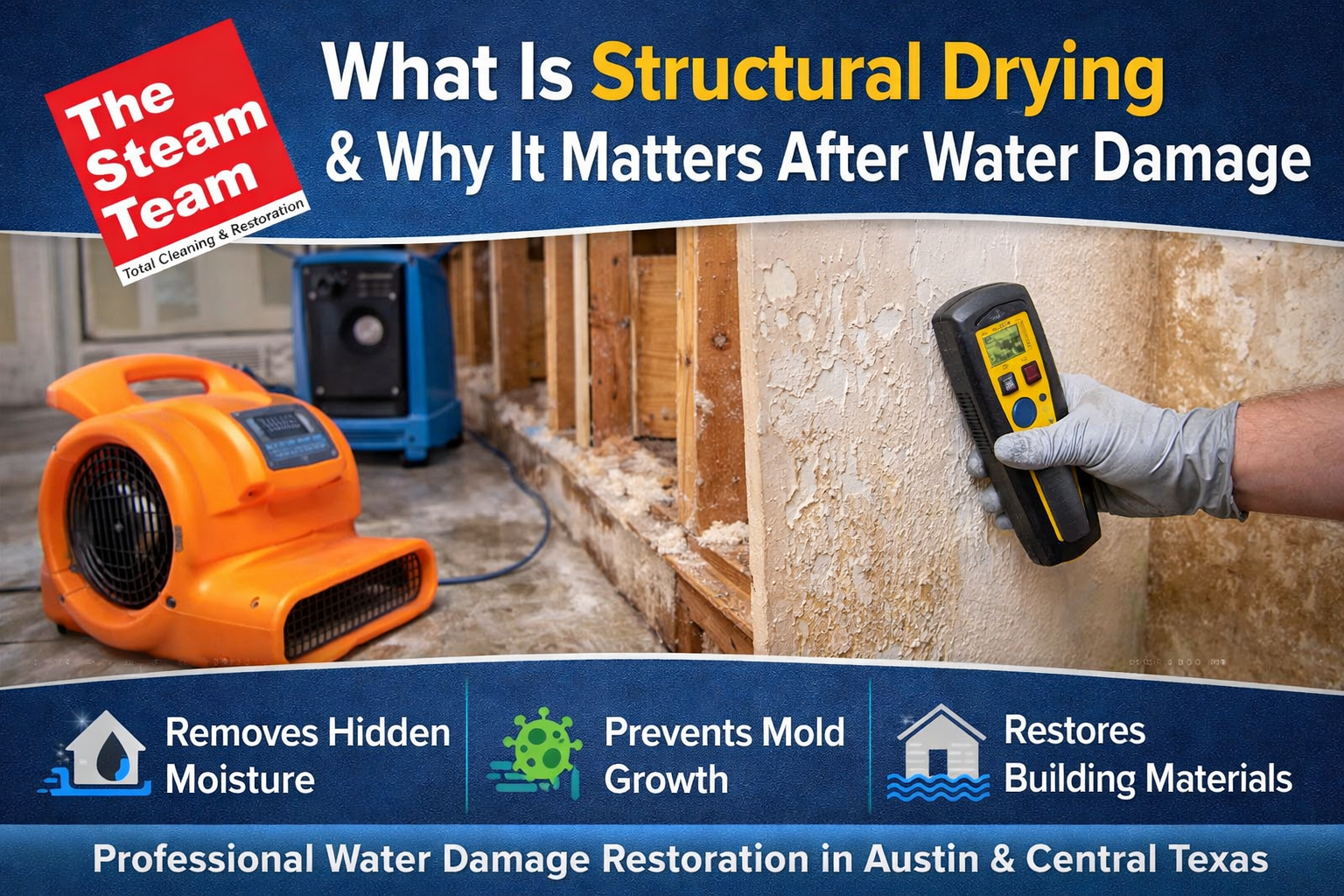
What Is Structural Drying and Why It Matters
/
When water damage occurs in a home or building, removing standing water is only the beginning of the restoration process.
Read More
Explore expert tips on water damage restoration, carpet cleaning, rug cleaning, mold remediation, and air duct cleaning in Austin, TX. Trusted local insights from The Steam Team since 1983.
When water damage occurs in a home or building, removing standing water is only the beginning of the restoration process.
Read MoreWater damage drying is the controlled process of removing water and moisture from building materials to prevent secondary damage such as mold growth, structural deterioration, and ruined contents. Rapid, measured drying reduces repair scope and cost by restoring equilibrium moisture content in materials through coordinated steps: extraction, directed airflow, dehumidification, and continuous monitoring. This article explains why fast, professional drying matters, outlines immediate homeowner actions, compares core drying techniques and equipment, and describes how to verify endpoints to prevent mold and long-term damage. You will learn practical safety checkpoints, the science behind refrigerant vs desiccant dehumidifiers, how air movers and injectidry systems reach hidden cavities, and which moisture metrics signal completion. Finally, the guide highlights local considerations for Austin and Central Texas climates, what advanced crews bring to complex jobs, and clear signs for when to escalate to professional restoration. Use the checklists and tables to make quick decisions on-site and to communicate effectively with insurers and service providers.
Immediate water damage drying begins with a fast triage: stop the source, ensure safety, remove standing water, and create airflow to start evaporation while documenting conditions for insurance. The mechanism is simple: reduce bulk water, accelerate surface evaporation with air movement, and extract airborne moisture with dehumidification, so each step prioritizes limiting contamination and structural weakening. Acting within the first 24–48 hours dramatically lowers mold risk and shortens total drying time, while measured extraction and containment preserve salvageable materials. The short workflow below offers a prioritized sequence homeowners and first responders can follow until professionals arrive.
Initial, practical steps for quick field triage:
Turn off electrical circuits serving wet areas if safe to do so and avoid standing water near outlets.
Remove people and pets from contaminated areas and isolate the loss zone with temporary containment.
Begin bulk water removal using pumps or wet vacuums and clear floor drains to reduce the standing water depth.
Create airflow by opening windows and running available fans toward exterior ventilation while keeping contaminated air contained.
This numbered workflow gives clear, actionable steps to reduce immediate risk. After removing bulk water, the next priority is verifying safety protocols and choosing extraction methods appropriate to the situation.
Ensuring safety means evaluating electrical hazards, contamination category, and structural compromise before any drying work begins. Electrical risk is high in flooded spaces; if water reaches outlets, panels, or appliances, cut power at the main or call the utility and a professional. Do not step into water near live power. Contaminated water (sewage, floodwater) requires PPE gloves, boots, N95 or higher respirators, and sometimes full protective suits and limits DIY attempts to removal of obvious solids and documentation. Structural concerns such as bulging ceilings or sagging floors should prompt evacuation and an engineered assessment. Document conditions with photos and notes for insurance; safe documentation aids recovery and maintains liability control.
These safety steps naturally lead to appropriate extraction choices, where equipment selection balances speed and contamination handling.
Professional water extraction targets both visible standing water and entrained moisture in fabrics and structural assemblies using a tiered approach of pumps, truck-mounted extractors, and portable units. Submersible pumps and surface pumps remove deep standing water quickly from large losses; truck-mounted extractors supply high vacuum and heat to pull moisture from carpets and porous substrates efficiently. Portable extractors and wet vacs are best for localized events or contained rooms where maneuverability matters. Choosing the right method reduces residual moisture and shortens the drying phase, which lowers mold risk and replacement costs.
Compare extraction methods and typical scenarios in the quick reference table below.
Extraction Method
Key Equipment
Typical Use Case / Best For
Submersible pumps
High-flow pumps, hoses
Large volumes of standing water in basements and garages
Truck-mounted extractors
High-vacuum units, heated vacuum
Fast removal from carpets, large-scale water losses
Portable extractors / wet vacs
Hand-portable vacuums, suction wands
Small areas, stairwells, and spot extraction
Mopping / manual removal
Buckets, squeegees
Quick mitigation when pumps are unavailable; limited for larger losses
This table clarifies which extraction technique matches common site conditions. Once bulk water is removed, effective drying shifts to combining airflow and dehumidification to remove remaining moisture from materials.
Professional drying techniques work together to move moisture from wet materials into the air and then remove that moisture from the environment; the core processes are extraction, airflow (air movers), dehumidification, heat application, and targeted structural drying. Evaporation is driven by airflow and temperature; dehumidifiers remove the vapor to maintain low relative humidity so evaporation continues. The right technique depends on material, temperature, humidity, and the presence of hidden moisture. Reviewing the mechanics and appropriate application for each technique helps choose the optimal combination for efficient, measurable drying.
Key techniques and when to use them:
Extraction: Removes bulk and bound water before drying, essential to shorten drying time and reduce contamination.
Air movers: Increase surface evaporation and direct airflow through wall cavities and assemblies.
Refrigerant dehumidification: Condenses moisture; ideal for moderate temperatures and typical indoor conditions.
Desiccant dehumidification: Adsorbs moisture; superior in low-temperature or extremely humid scenarios and for processing large moisture loads.
Selecting and sequencing these techniques forms the basis of structural drying plans and leads to specific equipment choices summarized below.
Technique
Key Equipment
Typical Application
Extraction
Pumps, extractors
Initial bulk water removal to reduce the load
Refrigerant dehumidification
LGR / refrigerant units
Common indoor environments, moderate temp/humidity
Desiccant dehumidification
Desiccant wheels, trailers
Low-temp or high-humidity sites, fast moisture adsorption
Directed airflow
Air movers, ducting
Surface drying and cavity drying support
Heat drying
Portable heaters, heat systems
Accelerates evaporation when balanced with dehumidification
Dehumidification removes moisture from air, lowering relative humidity so water continues to evaporate from wet materials into the atmosphere and then is captured by the dehumidifier. Refrigerant units condense water onto cold coils and are energy-efficient in typical indoor temperatures, while desiccant systems chemically adsorb moisture, maintaining effectiveness in colder or highly humid conditions. The selection depends on psychrometric targets: professionals calculate humidity ratios and set endpoints based on material-specific equilibrium moisture content. Proper dehumidification prevents reabsorption and shortens total project duration, offering measurable endpoints for closure. Understanding dehumidification mechanics leads to the correct pairing with air movers and containment strategies that direct vapor toward the dehumidifier inlet.
Air movers accelerate surface evaporation by increasing airflow over wet materials, disrupting boundary layers of humid air, and carrying moisture toward dehumidifiers. Placement strategy is critical: directed, overlapping airflow reduces dead zones and helps dry behind baseboards, under cabinets, and into wall cavities when combined with injectidry systems. Air mover capacity is measured in CFM and must be matched to room volume and material porosity; improper placement wastes energy and can prolong drying. Coordinating air movers with dehumidification maintains a gradient that encourages continuous evaporation without causing elevated humidity that would slow the process. This role of airflow naturally connects to methods for reaching hidden moisture through structural drying tools and diagnostics.
Structural drying targets moisture trapped in wall cavities, subfloors, and assemblies using non-destructive techniques injectidry hoses, cavity drying, and controlled pressure differentials guided by moisture mapping and thermal imaging. Technicians create containment and direct airflow into cavities, using targeted heat and low-profile injectors to force evaporation into accessible air streams. Thermal imaging and in-depth moisture meters locate pockets of retained moisture, reducing unnecessary demolition. When non-destructive methods cannot reach soaked materials, controlled openings or material removal are performed to prevent prolonged degradation. Structural drying depends on precise diagnostics and monitoring, which informs endpoint criteria and limits needless reconstruction.
Heat drying raises the vapor pressure of water in materials to increase the evaporation rate, often combined with dehumidification to capture the extra vapor generated. Portable heaters and heated desiccant systems are powerful accelerants for cold-season drying or when rapid turnaround is vital, but they raise safety considerations electrical load, fire risk, and possible warping of sensitive materials. Professionals balance heat with humidity control: too much heat without dehumidification only increases RH and slows drying. Controlled heat applications shorten project timelines when integrated into an overall drying plan with continuous monitoring. Appropriate heat application is a measured tool that reduces restoration time while maintaining safety and material integrity.
Preventing mold and secondary damage begins with fast drying and continues with sanitation, monitoring, and confirmation of drying endpoints. Mold can begin to colonize within 24–48 hours in favorable conditions, so reducing moisture quickly and maintaining low relative humidity is the core preventive action. Antimicrobial treatments, physical removal of contaminated materials, and proper drying protocols limit biological growth and persistent odors, but they are not substitutes for thorough drying and moisture verification. Documented monitoring and clear endpoints reassure homeowners and insurers that the property is stabilized and safe.
The checklist and monitoring practices below help teams and homeowners verify that drying has been effective and that microbial risks are minimized.
Dry the site within 24–48 hours when possible, using coordinated extraction, airflow, and dehumidification.
Apply surface sanitizers where contamination risk exists, but reserve deep antimicrobial treatment for confirmed colonization.
Use moisture meters, hygrometers, and thermal imaging to document progressive reduction in material moisture and room RH.
These prevention steps point directly to the tools used to apply antimicrobial work and to the need for rigorous monitoring protocols.
Antimicrobial treatments include surface sanitizers, encapsulants, and targeted biocides applied according to contamination type and material compatibility; they reduce viable spores and control odor but do not replace physical removal of heavily contaminated porous materials. Surface sanitizers are useful after drying to reduce residual microbial loads on hard, non-porous surfaces, while more aggressive interventions are reserved for significant mold growth that requires remediation. Trends favor safer, lower-toxicity chemistries for occupied spaces, and technicians must follow label instructions and regulatory guidance. Proper application accompanies containment, PPE, and disposal of affected materials to limit cross-contamination. Understanding antimicrobial options underscores why continuous moisture monitoring is necessary to confirm that re-colonization risks remain low.
Continuous monitoring uses a mix of tools, surface and pinless moisture meters, thermo-hygrometers for ambient conditions, and data-loggers for trend analysis to track drying progress and determine endpoints. A common workflow starts with baseline mapping, daily readings logged in consistent locations, and endpoint criteria based on manufacturer and industry standards for equilibrium moisture in specific materials. Target ranges often include stable moisture meter readings over consecutive days and relative humidity maintained below set thresholds, demonstrating that evaporation has ceased. Clear monitoring records provide the documentation needed for homeowner confidence and insurance claims. Consistent monitoring closes the loop from mitigation to successful restoration and informs any required reconstruction or contents restoration steps.
The Steam Team deploys industrial-grade drying equipment calibrated for Austin and Central Texas climate challenges, combining high-capacity refrigerant and desiccant dehumidifiers, directional air movers, thermal imaging cameras, and injectidry systems to locate and remove hidden moisture. Their crews are IICRC-certified, which supports measurable, standards-based drying decisions and thorough documentation. Equipment choice is tuned to local humidity and seasonal heat desiccants for peak humidity events and LGR refrigerant units for typical interior jobs so drying progresses efficiently while limiting invasive demolition. As a preferred vendor for major insurance carriers, their process emphasizes rapid response, documentation, and clear communication with adjusters to streamline claims.
Below is a practical equipment-to-outcome table showing typical functions and performance expectations in Austin’s climate.
Equipment
Function / Attribute
Expected Outcome
High-capacity refrigerant dehumidifier
Condenses airborne moisture in warm interiors
Steady RH reduction, efficient in moderate temps
Desiccant dehumidifier
Adsorbs moisture at low temps / high humidity
Maintains drying in saturated or cool conditions
Directional air movers
High CFM, focused airflow, ducting
Rapid surface evaporation, cavity drying support
Thermal imaging camera
Non-contact moisture visualization
Locates hidden moisture for targeted drying
Injectidry systems
Hose-driven cavity airflow
Non-destructive drying of wall and floor assemblies
IICRC-certified technicians apply standardized methodologies, psychrometric calculations, documented monitoring, and protocol-driven equipment selection that translate into reliable drying outcomes and defensible documentation for claims. Certification ensures crews understand equilibrium moisture content, the interplay of temperature and humidity, and when to escalate from non-destructive drying to controlled material removal. This competency reduces guesswork, shortens project timelines, and improves homeowner confidence through transparent reporting. Certification also supports consistent quality control checks throughout the restoration lifecycle. These quality controls complement advanced equipment choices and local operational experience.
State-of-the-art selections for Austin emphasize flexibility: high-capacity refrigerant units for standard interiors, desiccant systems for peak humidity or cool-season events, directional air movers for efficient evaporation, and thermal imaging plus moisture meters for verification. For large commercial or severe residential losses, trailer-mounted systems and combined airflow/dehumidification arrays process vast moisture loads. Choosing the right equipment combination avoids over-drying sensitive materials and prevents insufficient drying that leads to mold. Equipment choice directly affects drying rates and endpoint verification. The equipment table above maps common tools to anticipated outcomes so homeowners understand why each device appears on-site.
Local field experience matters because Austin’s seasonal heat and humidity, common building materials, and neighborhood response dynamics affect drying strategy and logistics. Crews familiar with local construction can anticipate trapped moisture in typical wall assemblies and select containment and injectidry tactics accordingly. Quick mobilization in the service area and established relationships with insurers shorten response times and reduce overall damage. Local expertise also means tuning dehumidification strategies for seasonal humidity swings to avoid prolonged jobs and repeated callbacks.
Local experience paired with disciplined monitoring produces faster, more predictable restorations and reduces downstream costs for homeowners.
Call professionals when the loss exceeds the scope of safe DIY mitigation, contamination is present, or structural elements are wet. Early professional intervention limits damage and cost escalation. Professionals bring calibrated equipment, IICRC best-practice workflows, and measurable endpoints; they also document conditions for insurance and coordinate reconstruction when needed. If standing water covers large areas, water is contaminated (sewage/floodwater), or visible mold appears within 24–48 hours, elevate to professional services immediately. The steps below explain what to expect when you request service and prepare for an efficient response.
Signs and triggers that warrant professional help:
Standing water covering more than a small room or deeper than a few inches.
Contaminated water (sewage, river/flood water) or unknown contamination.
Structural symptoms include sagging ceilings, compromised load-bearing elements, or bulging walls.
Persistent moisture readings or failed DIY drying after 24–48 hours.
This checklist clarifies escalation priorities and helps homeowners decide when to contact restoration professionals.
Concrete signs include visible mold growth or musty odors within 24–48 hours, persistent moisture meter readings above recommended endpoints, failed DIY attempts with lingering dampness, or health symptoms among occupants such as respiratory irritation. Structural cues warped floors, peeling paint, or efflorescence, indicate deeper moisture problems that require targeted diagnostics. Contaminated water events always require professional containment, sanitation, and documentation. When these signs appear, professional drying prevents secondary damage and supports insurance claims with measurable records. Recognizing these signs early reduces remediation scope and supports a safer, faster recovery process.
When requesting a quote or emergency response, provide concise information: the location of the loss, the type and extent of water (standing vs. damp), time elapsed since the event, and any known contamination. Expect an initial triage phone conversation followed by a rapid on-site assessment for emergency extraction and a documented drying plan. Professionals will outline equipment needs, monitoring frequency, and estimated timelines; they will also supply records for insurance. For urgent events, state that immediate extraction and drying are required to limit secondary damage and ask about 24/7 availability and response windows. Preparing photos and a simple damage log speeds assessment and helps service providers deliver an accurate, timely proposal.
For homeowners in Austin and Central Texas seeking emergency assistance, The Steam Team offers 24/7 emergency water damage restoration with IICRC-certified technicians and industrial drying equipment calibrated for local climate conditions. Their crews provide emergency water removal, advanced drying and dehumidification, moisture mapping with thermal imaging, and documented drying plans to support claims and reconstruction coordination. To request inspection or an emergency response, have basic details ready (type of water, affected areas, time elapsed); The Steam Team’s rapid-response process focuses on safety, containment, and measurable drying milestones to restore properties efficiently.
Common causes of water damage in homes include plumbing leaks, roof leaks, flooding from heavy rain, burst pipes, and appliance malfunctions, such as washing machines or water heaters. Additionally, poor drainage systems and foundation issues can lead to water accumulation. Homeowners should regularly inspect plumbing and roofing, maintain gutters, and ensure proper drainage to mitigate these risks. Understanding these causes can help in taking preventive measures and responding quickly when water damage occurs.
The duration of the water damage drying process can vary significantly based on several factors, including the extent of the damage, the materials affected, and the drying methods used. Generally, drying can take anywhere from 3 to 7 days for minor incidents, while more severe cases may require up to two weeks or longer. Professional assessment and equipment can expedite the process, ensuring that moisture levels return to normal as quickly as possible to prevent mold growth and structural damage.
If you notice mold after water damage drying, it is crucial to address it immediately to prevent further health risks and property damage. First, ensure that the area is safe and that moisture levels are controlled. Then, contact a professional mold remediation service to assess the situation. They can determine the extent of the mold growth and recommend appropriate removal methods. It’s essential to document the mold presence for insurance purposes and to ensure that the underlying moisture issue is resolved to prevent recurrence.
While some minor water damage situations can be managed by homeowners, it is often advisable to hire professionals for significant incidents. Professionals have the expertise, specialized equipment, and knowledge of safety protocols to effectively handle water extraction, drying, and mold prevention. If the damage involves contaminated water, structural concerns, or extensive areas, professional intervention is essential to ensure thorough and safe restoration. DIY efforts may lead to incomplete drying and increased risks of mold and structural damage.
Water damage restoration may be covered under various types of insurance policies, primarily homeowners' insurance. Coverage typically includes damage from sudden and accidental incidents, such as burst pipes or appliance failures. However, it often excludes damage from flooding, which usually requires separate flood insurance. It's essential to review your policy details and consult with your insurance agent to understand your coverage limits, deductibles, and any specific exclusions related to water damage restoration.
To prepare your home for potential water damage, start by regularly inspecting and maintaining plumbing, roofs, and gutters. Ensure that downspouts direct water away from the foundation and consider installing a sump pump in basements prone to flooding. Additionally, keep valuable items elevated and create an emergency plan that includes contact information for restoration services. Having a water damage response kit with essential tools and supplies can also help you act quickly in case of an emergency.
If water damage is not addressed promptly, it can lead to severe long-term effects, including structural damage, mold growth, and compromised indoor air quality. Prolonged moisture can weaken building materials, leading to costly repairs and safety hazards. Mold can cause health issues, particularly for individuals with respiratory conditions or allergies. Additionally, lingering moisture can result in persistent odors and damage to personal belongings. Timely intervention is crucial to mitigate these risks and ensure a safe living environment.
Effective water damage drying is essential for preventing mold growth and structural deterioration, ensuring a safe and healthy living environment. By understanding the best techniques and equipment, homeowners can make informed decisions that minimize damage and expedite recovery. Engaging professional services not only enhances drying efficiency but also provides peace of mind through documented processes and expert guidance. For immediate assistance, contact The Steam Team to explore tailored solutions for your water damage needs.
Our mission is to provide you with the most outstanding service experience ever. Some of our most popular services include Carpet Cleaning, Tile Cleaning, Air Duct Cleaning, Water Damage, Fire Damage Restoration and Construction Services.
Quick Cleaning Quote
Email:
customerservice@thesteamteam.com
Georgetown: (512) 868-0358
Dallas: (214) 631-8326
Naples, FL: (239) 450-1936
Toll Free: (800) 880-7785
Professional cleaning and restoration services based in Austin, Texas. Serving homes and businesses since 1983 with certified technicians, advanced equipment, and 24/7 emergency response.
Cleaning Office – Central Austin
1904 W Koenig Ln
Austin, TX 78756
(512) 450-7199
customerservice@thesteamteam.com
Monday: 8am - 5pm
Tuesday: 8am - 5pm
Wednesday: 8am - 5pm
Thursday: 8am - 5pm
Friday: 8am - 5pm
Saturday: 8am - 5pm
Sunday: Closed
Restoration Office – North Austin
9901 Burnet Rd
Austin, TX 78758
(512) 451-8326
customerservice@thesteamteam.com
Monday: Open 24 hours
Tuesday: Open 24 hours
Wednesday: Open 24 hours
Thursday: Open 24 hours
Friday: Open 24 hours
Saturday: Open 24 hours
Sunday: Open 24 hours


© The Steam Team