Unlocking Hot Water Extraction Magic
Hot water extraction carpet cleaning (often shortened to HWE) uses a coordinated combination of heat, chemistry, mechanical agitation, and high-powered vacuum recovery to remove soils, allergens, and odor-causing compounds from deep within carpet fibers. This article explains the underlying physics and chemistry of how heated water and surfactant chemistry lower surface tension, how pressurized injection displaces bonded soils, and how vacuum recovery captures suspended particulates, so readers understand why HWE delivers measurable cleaning outcomes. Homeowners and facility managers often face stubborn stains, pollen loads, pet dander, and humidity-driven microbial risk; understanding the mechanisms behind HWE clarifies when professional HWE is the right choice versus other approaches. Below we map the step-by-step process, the health and fiber-restoration benefits, a direct comparison with what is commonly called steam cleaning, the chemistry behind effective cleaning solutions, the equipment and innovations that improve performance, and specific adaptations for Austin and Central Texas climates. Throughout, semantic links between heat → reaction rate → soil emulsification and vacuum → pressure differential → extraction are emphasized to show cause-and-effect for practical decisions about cleaning frequency and methods.
What Is Hot Water Extraction and How Does the Process Work?
Hot water extraction is a professional carpet cleaning method that injects heated cleaning solution into the carpet pile under controlled pressure and immediately extracts the suspension with a strong vacuum, producing deep soil removal without excessive residual moisture. The mechanism combines heat-driven increases in chemical reaction rates, surfactant-mediated emulsification of hydrophobic soils, and pressure-differential extraction to physically remove contaminants from fibers. The result is a reduction in trapped particulates and soluble soils that improves appearance and indoor air quality. Key operational variables nozzle temperature, injection pressure, solution concentration, and recovery vacuum, must be balanced to maximize soil removal while minimizing moisture retention and fiber stress.
What Are the Key Steps in the Hot Water Extraction Process?
Hot water extraction follows a repeatable sequence that pairs each mechanical action with a specific scientific rationale and outcome. The process begins with a systematic inspection and pre-treatment of traffic lanes and stain zones to loosen oxidized soils and target hydrophobic residues. Next, a heated cleaning solution is injected under pressure while mechanical agitation via brush, groomer, or wand agitation disrupts packed soils and helps surfactants encapsulate oils and particulate matter. Powerful vacuum recovery immediately follows injection to capture suspension and reduce residual moisture, and the procedure finishes with pile grooming and airflow management to restore appearance and accelerate drying. Typical drying times vary with humidity and extraction effectiveness; accurate extraction and recovery are essential to keep drying time low and microbial risk minimal.
Key steps in HWE include pre-inspection and pre-treatment, heated solution injection, agitation to mobilize soils, high-volume extraction, and post-clean grooming.
These steps align science to outcome: pre-treatment alters soil chemistry, heat accelerates reactions, agitation breaks bonds, and vacuum removes the suspension.
This clear procedure ensures each scientific mechanism directly supports the practical goal of deep, residue-minimized cleaning.
How Do Heat, Pressure, and Vacuum Physics Enhance Cleaning?
Heat raises the kinetic energy of molecules, reducing surface tension and accelerating surfactant action, so soils detach from fiber surfaces more readily under warm conditions. Pressure-driven injection forces solution into the carpet matrix, overcoming capillary hold and embedded soil adhesion; higher injection pressures improve penetration but must be modulated to avoid fiber and backing stress. Vacuum recovery creates a pressure differential that mechanically lifts suspended particles and solution into the recovery tank; efficient recovery reduces retained moisture and decreases the window for microbial growth. Together, these physical forces, thermal activation, hydraulic penetration, and suction extraction create a coordinated system where each variable amplifies overall cleaning efficiency while minimizing collateral effects like over-wetting or residue.
Surfactant-Assisted Pressurized Hot Water Extraction for Marker Compounds
Pressurized hot water extraction (PWHE) is a technique that uses heated water at temperatures above its boiling point, but below its critical point, under pressure to extract compounds from a sample. The high temperature increases the solubility of many organic compounds, while the pressure keeps the water in a liquid state. Surfactants can be added to enhance the extraction efficiency by reducing the surface tension of the water and improving the penetration of the solvent into the sample matrix.
Evaluation of surfactant‐assisted pressurized hot water extraction for marker compounds in Radix Codonopsis pilosula using liquid chromatography and liquid …, ES Ong, 2003
What Are the Benefits of Hot Water Extraction for Deep Carpet Cleaning?
Hot water extraction delivers benefits that are traceable to measurable mechanisms: improved allergen and microbial removal because of heat and extraction; stain and odor reduction through surfactant emulsification and removal of odor precursors; and fiber restoration by removing abrasive soils that abrade pile and flatten fibers. These outcomes translate into better indoor air quality, reduced odor recurrence, and improved carpet appearance and longevity when performed with proper rinse and recovery. For property owners, the value lies in combining health outcomes with asset preservation: removing trapped soils prevents ongoing abrasion while extracting allergens that resuspend into indoor air. Below is a structured representation of the benefits tied to the mechanism and expected outcome.
Benefit Area
Mechanism
Typical Outcome
Allergen reduction
Heat + extraction of particulates and dander
Significant reduction in airborne resuspension and settled allergen load
Microbial load control
Elevated temperature + mechanical removal
Lower viable counts and reduced odor-causing biomass
Fiber restoration
Removal of abrasive soils and proper rinsing
Improved pile loft, appearance, and reduced long-term wear
This table shows how scientific mechanisms map directly to homeowner-relevant outcomes: cleaner air, fewer odors, and preserved carpet life. Understanding these links helps set realistic expectations for cleaning frequency and post-clean care.
For practical planning, homeowners should consider these three advantages:
Health-oriented cleaning: HWE reduces pollen, pet dander, and dust mite reservoirs that contribute to indoor allergen exposure.
Appearance restoration: By removing embedded soils, HWE restores pile texture and color vibrancy.
Longevity: Eliminating abrasive particles slows fiber wear, preserving carpet investment.
After evaluating scientific benefits and practical outcomes, many readers want a reliable local provider to execute HWE with consistent equipment and controls. The Steam Team provides professional hot water extraction services across Austin and Central Texas, staffed by IICRC-certified technicians and supported by an A+ BBB rating and 24/7 emergency service availability. For homeowners and businesses seeking an evidence-based, reliable clean, The Steam Team invites requests for quotes or to schedule an appointment via phone; their local expertise aligns scientific cleaning practices with practical scheduling to address health and appearance goals.
How Does Hot Water Extraction Remove Allergens, Bacteria, and Odors?
Hot water extraction removes allergens and microbes through a combination of thermal stress, surfactant-enabled suspension, and efficient extraction that physically removes particles from the carpet matrix. Heat can denature some microbial proteins and weaken adhesion forces holding dust mite fragments and pollen grains, while surfactants emulsify oils and odor precursors to create a water-compatible suspension. High-volume vacuum recovery then captures suspended particulates and microbes in the recovery tank rather than allowing resettlement. This mechanism reduces both settled allergen reservoirs and the potential for patient exposure through resuspension during daily activity, improving indoor air quality when paired with effective pre-treatment and rinsing.
How Does Hot Water Extraction Improve Carpet Fiber Restoration and Longevity?
Removing abrasive soils that embed between fiber strands is the primary way HWE restores pile and slows wear; as grains of dirt are removed, fibers regain loft and reflect light more evenly, improving appearance. Proper chemistry selection and rinsing prevent sticky residues that re-attract soil; maintaining near-neutral rinse pH and using low-residue detergents protect fiber integrity. Repeated, controlled HWE cycles scheduled based on traffic patterns and local contaminant loads prevent progressive abrasion and extend service life. In practice, homeowners who pair timely HWE with routine vacuuming see fewer wear patterns and longer intervals before replacement is needed.
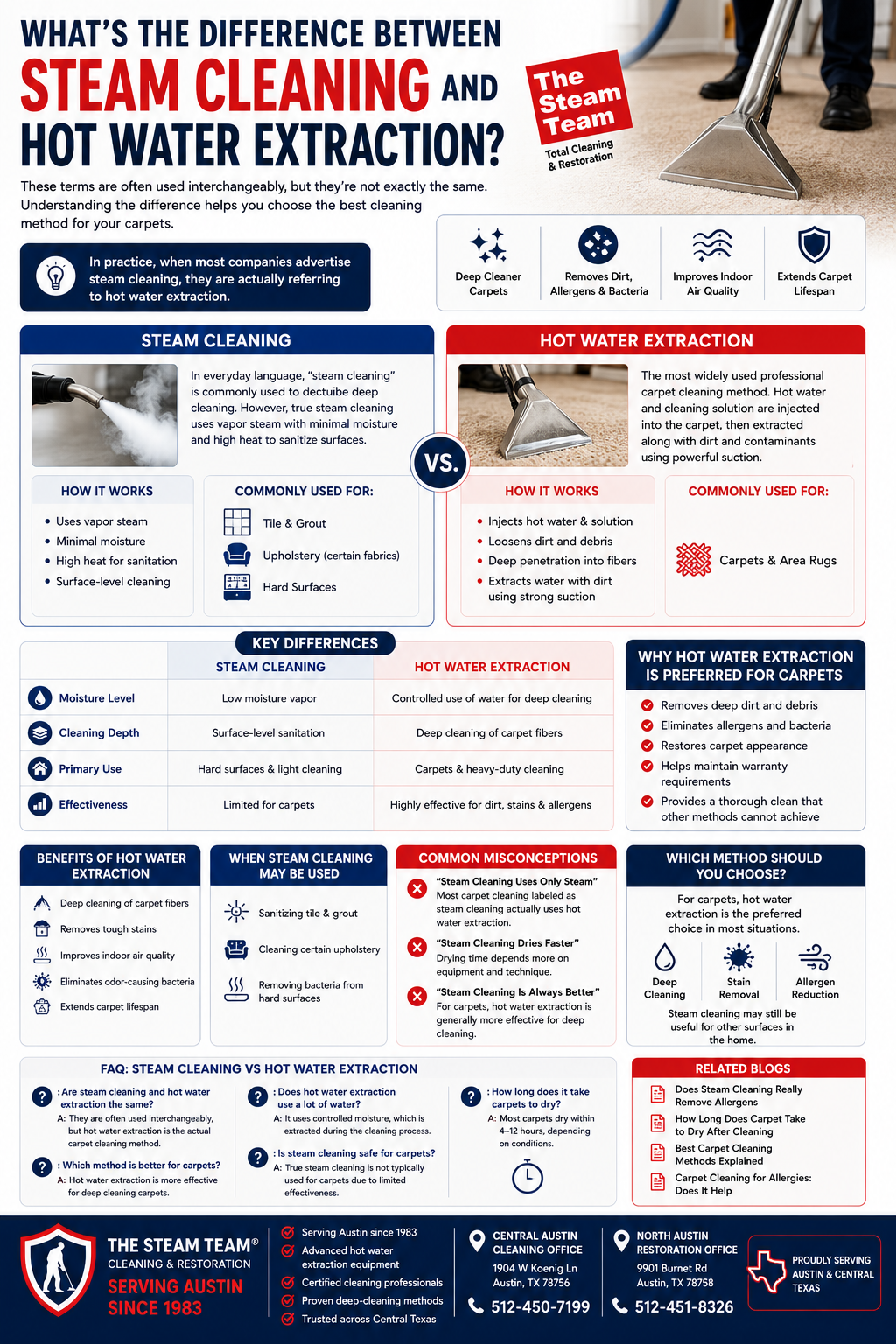
How Does Hot Water Extraction Compare to Steam Cleaning?
At the top level, hot water extraction uses heated liquid combined with immediate extraction, whereas true steam cleaning uses high-temperature vapor with minimal liquid volume; they are related but not identical approaches. Hot water extraction typically operates with nozzle temperatures in the range of roughly 150–210°F at the point of contact while delivering measurable liquid for suspension and vacuum recovery. True steam methods rely on vapor temperatures that can be higher but often leave less solvent action and limited extraction, affecting residue and soil-lift outcomes. The practical implication is that HWE balances chemical and mechanical mechanisms to remove both soluble and particulate soils, whereas vapor-only approaches emphasize thermal kill but may be less effective at removing suspended particulate reservoirs.
Method
Key Attribute
Practical Impact
Hot Water Extraction (HWE)
Heated solution + high-volume extraction
Thorough removal of soluble and particulate soils with controlled drying
True Steam Cleaning
High-temperature vapor, low liquid
Strong thermal effect but limited soil suspension and extraction
Low-moisture systems
Encapsulation/dry methods
Fast drying but less effective for embedded particulates
The table clarifies that while both approaches can reduce microbes under certain conditions, HWE provides more consistent particulate removal and lower long-term residue when properly rinsed and extracted.
What Are the Temperature and Moisture Differences Between HWE and Steam Cleaning?
Numerically, HWE nozzle temperatures often reach the 150–210°F window, which speeds chemical reactions without over-saturating backing materials when properly controlled. Steam-cleaning vapor temperatures can technically exceed those ranges at the generator, but deliver far less liquid; consequently, steam methods present lower net moisture transfer but limited physical removal of suspended soils. Moisture profiles after HWE depend on recovery efficiency; effective extraction leaves carpet surface damp but dries in an acceptable window, whereas inadequate extraction leaves extended dampness that increases microbial risk. Understanding these temperature and moisture trade-offs helps operators select settings that maximize soil removal while preserving backing and pad.
Pressurized Hot Water Extraction: Principles and Applications
Pressurized hot water extraction (PHWE), also known as subcritical water extraction, superheated water extraction, or accelerated solvent extraction using water as a solvent, utilizes water at temperatures above 100 °C and pressures above atmospheric pressure. Under these conditions, water exhibits unique properties, such as reduced polarity and increased solvating power for organic compounds, making it an effective extraction solvent.
Pressurized hot water extraction of bioactives, M Plaza, 2017
How Do Drying Times and Residue Impact Carpet Health?
Drying time is a critical variable because prolonged moisture retention raises the risk of mold and odor development, and residues from cleaning solutions can accelerate soil re-attraction and fiber breakdown. Recommended drying times after properly executed HWE typically fall within a range that depends on ambient humidity and extraction efficiency; quick and effective recovery plus airflow management keeps drying within safe windows and minimizes microbial proliferation. Residue prevention relies on proper formulation selection (low-residue detergents), adequate rinse steps, and sufficient vacuum recovery; residues that remain act as tackifiers, attracting particulate re-deposition and degrading carpet aesthetics. Minimizing residual chemicals and moisture both protects manufacturer warranties and improves long-term fiber performance.
What Is the Chemistry Behind Effective Carpet Cleaning Solutions in Hot Water Extraction?
Effective HWE chemistry balances surfactant selection, pH control, and solvent strength to target specific soil classes without damaging fibers. Surfactants, both anionic for particulate suspension and nonionic for oily soil emulsification, lower surface tension and form micelles that encapsulate oils into water-compatible structures for extraction. pH modulation targets stain chemistry: alkaline formulations help saponify and lift greasy soils, while acidic rinses can neutralize alkaline residues and aid in removing mineral-based discoloration. The optimal approach often uses an integrated sequence: pre-treatment with targeted chemistries, an extraction solution tuned for fiber safety, and a neutral rinse to leave minimal residue.
How Do Surfactants and pH Balance Work to Break Down Dirt and Stains?
Surfactants reduce surface tension and encapsulate hydrophobic soil into micelles, enabling suspension in water for vacuum recovery; anionic surfactants excel at lifting particulate and charged soils, while nonionic surfactants are effective with oily, hydrophobic residues. pH influences chemical reactivity: alkaline cleaners saponify fats and break down organic soils, whereas acidic rinses help dissolve mineral salts and set dyes in a stable state. Matching pH to fiber type is essential; some synthetic fibers tolerate broader pH ranges, but natural fibers require gentler chemistry. The science-to-practice rule is: use surfactants to mobilize soils and pH control to target soil chemistry while ensuring a neutral final rinse to prevent residue buildup.
What Role Do Eco-Friendly Cleaning Agents Play in Hot Water Extraction?
Eco-friendly agents, including biodegradable surfactants and low-VOC formulations, reduce environmental impact and indoor chemical exposure while still providing solid emulsification and rinsing properties. Performance trade-offs exist: some green formulations have reduced foaming or different solubilization profiles, requiring adjusted application strategies and mechanical agitation to achieve equal results. For many clients, reduced residue and lower odor profiles are compelling advantages, especially in sensitive environments. Recent industry trends show growing adoption of certified green agents when paired with professional HWE protocols that compensate for formulation differences through precise temperature, agitation, and extraction control.
What Advanced Equipment and Technology Are Used in Hot Water Extraction?
Equipment advances amplify HWE outcomes by delivering consistent temperature, modulated pressure, and high-rate recovery to reduce moisture retention and improve soil lift. Truck-mounted systems deliver higher PSI and greater heat capacity, enabling faster throughput on large jobs, while portable units offer access flexibility for tight or multi-level properties. Wand design, flow-path engineering, and recovery tank configurations further influence extraction efficiency; innovations like modulated heating and recovery flow control permit consistent performance across variable job conditions. Below is a comparative table outlining truck-mounted systems versus portable units on core attributes.
System Type
Attribute
Typical Impact
Truck-mounted
Higher PSI, greater heat capacity
Faster extraction, superior recovery rates for large/commercial jobs
Portable unit
Greater portability, lower footprint
Access to tight spaces and multi-floor apartments, where truck access is limited
Wand and recovery system
Nozzle design, flow-path efficiency
Directly affects moisture removal and fiber stress
This table emphasizes choosing equipment based on access constraints and performance needs rather than assuming one-size-fits-all.
How Do Truck-Mounted Systems and Portable Units Differ in Performance?
Truck-mounted systems generally offer higher continuous heat and stronger vacuum recovery, translating to improved water recovery rates and shorter drying times on larger projects. Portables sacrifice some thermal and recovery capacity for flexibility, making them preferable for interior-only access or multi-unit buildings. Water recovery rate, PSI capability, and sustained temperature are the primary performance variables; matching system choice to job scale and access ensures efficient cleaning without unnecessary fiber stress. Provider-grade truck units combined with trained technicians yield throughput and extraction efficiency that reduce duration and moisture risk on heavy-duty jobs.
The Steam Team uses provider-grade truck-mounted systems and employs IICRC-certified technicians to validate equipment-driven claims; this combination supports predictable temperature and recovery control that improves cleaning consistency. For homeowners and businesses wanting a reliable quote or to schedule a visit for an inspection-based recommendation, The Steam Team offers local service scheduling and estimates by phone.
What Innovations in Water Heating and Pressure Regulation Improve Results?
Recent innovations include modulated heating systems that maintain consistent nozzle temperatures under varying flow rates, and pressure-control valves that adjust injection force to match fiber sensitivity and soil load. Improved recovery pumps and baffled recovery tanks reduce aeration and filter out fine particulates, increasing capture efficiency and shortening drying times. Wand designs that optimize contact angle and flow-through recovery can further reduce residual moisture while preserving pile integrity. These engineering improvements translate into measurable outcomes: greater soil removal efficiency, fewer rinse passes, and lower post-cleaning moisture percentages.
How Does Hot Water Extraction Address Local Austin and Central Texas Carpet Cleaning Challenges?
Local environmental factors in Austin and Central Texas seasonal pollen, plant-based soils, clay-rich dust, and periods of elevated humidity, change contaminant profiles and influence optimal HWE settings. Pollen and plant debris are often hydrophobic or adhesive and respond well to targeted pre-treatment and surfactant selection, while clay and mineral soils require agitation and effective rinse to avoid abrasive re-deposition. High humidity slows drying and increases microbial risk, making aggressive extraction and post-clean airflow strategies essential in the region. Tailoring chemical sequence, equipment settings, and drying protocols to these regional attributes yields better health and appearance outcomes.
How Does HWE Tackle Austin-Specific Allergens and Soil Types?
In Austin, common allergens such as seasonal pollen and plant particulates bind to fibers and settle into the pile; pre-treatment with surfactants that target sticky organic residues and mechanical agitation loosens these particulates for extraction. Clay and mineral soils brought in from outdoor activity require robust suspension and adequate rinsing to prevent fine abrasive retention. Adjusting cleaning cadence more frequent HWE during high pollen seasons reduces the cumulative reservoir of allergens. Homeowners are advised to coordinate HWE scheduling around peak pollen periods and high-traffic events to maintain indoor air quality and reduce allergen resuspension.
Local tactics include pre-treatment for organic soils, mechanical agitation for clay removal, and scheduling during lower-humidity windows where possible.
Recommended cadence increases during allergy season and after major outdoor events that elevate indoor soil loads.
These practical adaptations help ensure HWE addresses both the chemical nature of local soils and the mechanical demands of extraction.
What Are the Effects of Humidity and Climate on the HWE Process?
Higher humidity extends drying times and raises the risk of microbial activity if extraction and ventilation are insufficient, so mitigation requires increased extraction passes, use of high-capacity recovery systems, and active air movement or dehumidification post-clean. In drier periods, less extraction may suffice, but consistent rinsing to prevent residue remains important. Practical scheduling advice is to favor morning or mid-day appointments that allow natural ventilation and sunlight to assist drying when outdoor humidity is lower. Providers who monitor ambient conditions and adjust process variables more extraction, stronger recovery, and air movers when needed, minimize post-clean moisture retention and associated risks.
Pre-treatment and agitation reduce bonded pollen and clay.
Aggressive extraction and airflow limit drying time in humid months.
Seasonal scheduling keeps allergen reservoirs low and preserves indoor air quality.
This regional approach ensures that the scientific principles of HWE are applied where local contaminants and climate create specific risks and opportunities for improved outcomes.
Frequently Asked Questions
What types of carpets are best suited for hot water extraction cleaning?
Hot water extraction is effective for a wide range of carpet types, including nylon, polyester, and olefin. However, natural fiber carpets like wool may require more careful handling due to their sensitivity to heat and moisture. It's essential to assess the carpet's material and construction before proceeding with HWE to avoid damage. Consulting with a professional cleaner can help determine the best approach for specific carpet types, ensuring optimal cleaning results without compromising fiber integrity.
How often should I schedule hot water extraction cleaning for my carpets?
The frequency of hot water extraction cleaning depends on several factors, including foot traffic, the presence of pets, and local environmental conditions. Generally, high-traffic areas may benefit from cleaning every 6 to 12 months, while less frequented spaces can be cleaned every 12 to 18 months. During allergy seasons or after significant events that increase soil levels, more frequent cleaning may be necessary. Regular maintenance, including vacuuming, can also extend the time between professional cleanings.
Can hot water extraction help with pet stains and odors?
Yes, hot water extraction is particularly effective at removing pet stains and odors. The combination of heat, surfactants, and vacuum recovery works to break down and lift pet-related soils, including urine and feces, from carpet fibers. Pre-treatment with specialized enzymatic cleaners can enhance the effectiveness of HWE by targeting organic stains and neutralizing odors. For best results, it's advisable to address pet accidents promptly and consult a professional cleaner experienced in handling such issues.
What should I do to prepare my home for a hot water extraction cleaning?
Preparing your home for hot water extraction cleaning involves several steps. First, remove any furniture or items from the carpeted areas to ensure unobstructed access. Vacuum the carpets thoroughly to eliminate loose dirt and debris. If there are specific stains or problem areas, inform the cleaning technician so they can apply targeted treatments. Additionally, ensure that the cleaning area is accessible, and consider scheduling the cleaning when you can allow for adequate drying time afterward.
Are there any risks associated with hot water extraction cleaning?
While hot water extraction is generally safe and effective, there are some risks to consider. If not performed correctly, excessive moisture can lead to mold growth or damage to carpet backing. Additionally, using incorrect cleaning solutions can harm fibers or leave residues. To mitigate these risks, it's crucial to hire a qualified professional with experience in HWE. They will use appropriate techniques and equipment to ensure thorough cleaning while minimizing moisture retention and protecting your carpets.
How does hot water extraction impact indoor air quality?
Hot water extraction can significantly improve indoor air quality by removing allergens, dust, and microbial contaminants trapped in carpet fibers. The process effectively extracts pollutants such as pet dander, pollen, and dust mites, which can contribute to respiratory issues. By reducing these allergens, HWE helps create a healthier living environment. Regular cleaning also prevents the buildup of odors and improves overall air circulation, making it an essential practice for maintaining good indoor air quality.
What is the typical drying time after hot water extraction cleaning?
Drying time after hot water extraction cleaning typically ranges from 2 to 6 hours, depending on several factors, including humidity, airflow, and the effectiveness of the extraction process. Properly executed HWE should leave carpets damp but not overly wet. To expedite drying, it's beneficial to use fans or dehumidifiers and to maintain good ventilation in the cleaned areas. Scheduling cleaning during lower humidity periods can also help reduce drying times and minimize the risk of microbial growth.
Conclusion
Hot water extraction carpet cleaning offers significant benefits, including improved indoor air quality, effective allergen removal, and enhanced carpet longevity. Understanding the science behind this method empowers homeowners to make informed decisions about their cleaning needs. For those seeking reliable and professional services, The Steam Team is ready to assist with expert hot water extraction tailored to your specific requirements. Contact us today to schedule your appointment and experience the difference in your home.